

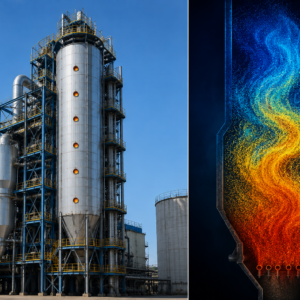
Ammonia is gaining attention as a carbon-free fuel that could help reduce emissions from coal-fired power generation. Since it is already produced, stored, and transported at industrial scale for fertilizer and chemical use, much of the infrastructure needed to burn it as fuel already exists.
Ammonia contains nitrogen, so while blending it with coal cuts carbon dioxide output, it can also raise nitrogen oxide emissions. Any co-firing strategy must therefore manage both effects together.
To study this, CPFD Software used its Barracuda Virtual Reactor software to first validate a combustion chemistry model against pilot-scale test data, matching temperature, gas composition, and emissions. That same chemistry was then applied to a full, production-scale coal-fired boiler model, confirming accuracy at industrial scale.
With this validated model in place, the latest simulation introduces ammonia co-firing at increasing levels, replacing part of the coal feed and tracking oxygen, carbon dioxide, nitrogen oxide, and water vapor from the bottom to the top of the furnace.
The results show:
- Carbon dioxide emissions decrease steadily as ammonia replaces coal.
- Water vapor output rises, reflecting ammonia’s hydrogen-rich combustion.
- Nitrogen oxide rises sharply near the furnace base, partially declines further up, but overall outlet levels still increase with more ammonia use.
This progression, from pilot validation to industrial scaling to ammonia evaluation, shows how simulation helps plants assess co-firing strategies before real-world changes.
Image generated by: ChatGPT