

Light
Dark
Loading
*to close search form press ESC or close toggle
Tag: Electronics and Telecommunication
12 events found.
Electronics and Telecommunication
Events
-
-

Mathworks webinar: Model-Based Design Meets Agentic AI
This webinar examines how Model-Based Design supports validation of AI-assisted engineering, using Simulink for requirements traceability, simulation, and production-ready verification. It aims to show how AI agents can automate test harness creation, scenario generation, and embedded integration tasks, while explaining how simulation and code generation workflows preserve repeatability and accountability for complex, safety-relevant systems. For […]
-
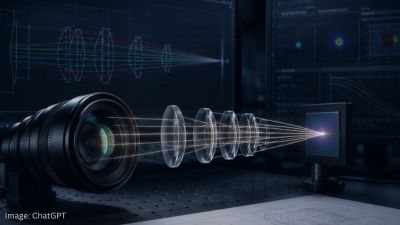
Keysight webinar: CODE V Discovery Training
This CODE V Discovery Training introduces an optical design software used to design, analyze, and optimize systems including camera lenses, telescopes, and photonics devices. It aims to familiarize participants with ray tracing, diffraction analysis, optimization, tolerancing, key considerations in imaging system design, and the software's interface and workflow. No prior CODE V experience is required. […]
-
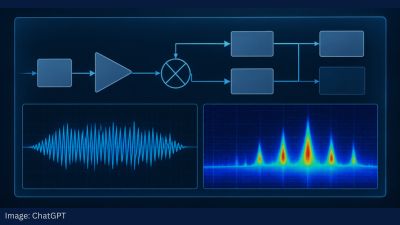
Mathworks webinar: Connecting Requirements, Architecture, & Simulation
This webinar addresses how disconnected workflows can increase implementation risk, delay decisions, and create rework in radar development. Using a radar Transmit/Receive Module as a case study, it aims to show how model-based systems engineering connects requirements, architecture, simulation, and verification through a unified workflow and digital thread. Topics include System Composer, linking requirements from […]
-

Ansys webinar: Scaling and Optimizing Data Center Cooling
This webinar explores a "chip-to-rack" approach to thermal management in AI data centers, covering the shift from air to liquid cooling. It aims to cover direct-to-chip, cold plate, immersion, and two-phase cooling methods, along with multiphysics simulation tools such as Ansys Icepak, Fluent, Thermal Desktop, RedHawk-SC ET, and TwinBuilder. Real-world applications involving AI GPUs, liquid-cooled […]
-
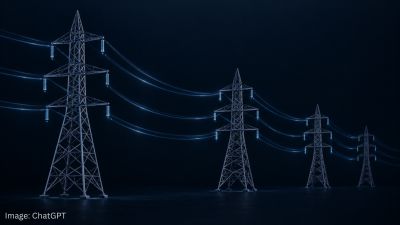
Mathworks webinar: Probabilistic Power Flow using MATLAB, MATPOWER
This webinar aims to explore probabilistic power flow using MATLAB and MATPOWER to assess power system performance under uncertainty. It covers moving from static planning cases to scenario-based analysis, including data preparation, uncertainty modelling, large-scale power flow simulations, and interpretation of constraint violations and risk exposure. Applications include renewable variability, electrification, data centers, network reinforcement, […]
-
-
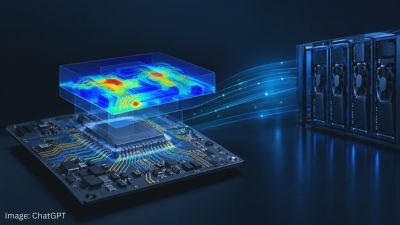
Cadence webinar: GPU-Accelerated 3D Electromagnetics
This webinar aims to explore how GPU acceleration can support large-scale 3D electromagnetic (EM) simulations for PCB and package design. It covers Cadence’s Clarity 3D Solver, benchmark results from production-oriented cases, GPU impact areas, compute configuration considerations, potential effects on engineering throughput, and upcoming capabilities, with examples spanning package extraction and large PCB signal integrity […]
-
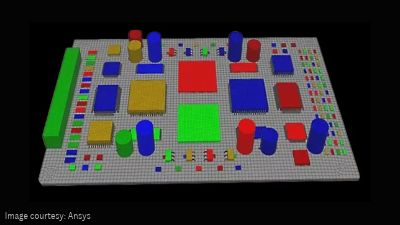
Webinar: Accelerating Design with Ansys Sherlock 2026 R1
The webinar "Accelerating Reliability-Driven Design with Ansys Sherlock 2026 R1" aims to explore the latest electronics reliability updates in Sherlock. It covers the Sherlock App in Ansys Mechanical, thermal rainflow cycle counting, and Thermal-Mechanical BGA package life prediction. The session aims to provide deeper insight into reliability workflows, fatigue analysis, and reliability scoring and reporting. […]
-
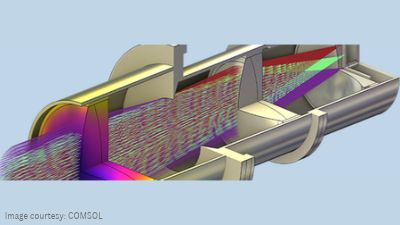
Comsol webinar: Modeling Structural-Thermal-Optical Performance
Optical systems at high altitudes, in space, underwater, and high-power laser and nuclear applications face structural loads and extreme temperatures. This webinar aims to show how COMSOL Multiphysics® couples ray-tracing with structural and thermal analyses in a self-consistent structural-thermal-optical performance (STOP) model, accounting for thermal stress, deformation, and temperature-dependent refractive index effects on ray trajectories, […]
-
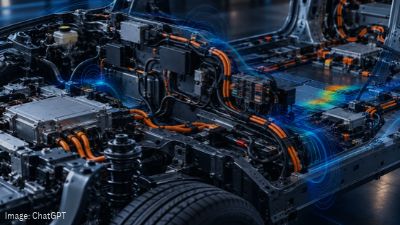
Ansys webinar: Power Electronics Digital Twins
This webinar aims to demonstrate how Saber enables virtual prototypes, or digital twins, of power electronics and motor drive systems, integrating electrical, thermal, magnetic, hydraulic, mechanical, and control domains in one environment. It covers modeling of semiconductors, motors, cooling systems, and mechanical loads, digital control validation, system-level performance, stress, and margin analysis, optimization, reliability, functional […]
-
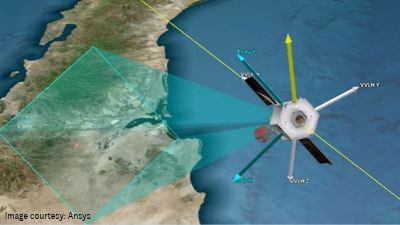
Ansys webinar: Digital Beamforming Design
The webinar "Digital Beamforming Design: From Optimization to Verified Performance" explores digital beamforming design through automated trade studies, antenna geometry optimization, and high-fidelity electromagnetic simulation using Ansys HFSS. It aims to show how results are verified against system requirements, while PLM and SPDM connect data, processes, and systems into a digital thread that supports traceability […]
-
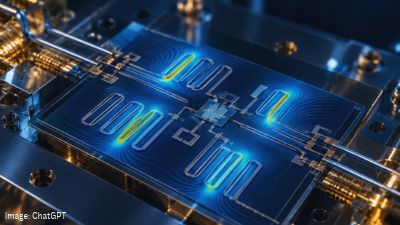
Dassault Systèmes webinar: EM Simulation for Quantum Hardware Design
The webinar examines how electromagnetic simulation can support quantum hardware design, covering high-density multichannel I/O interconnects, the flex-to-coax segment (RF transitions, filters, flexible PCB) and metrics such as return loss, insertion loss and crosstalk. It also addresses chip-level, CST-based 3D modelling of transmons, resonators and feedlines using eigenmode and frequency-domain solvers, including anharmonicity, Q-factor and […]
-
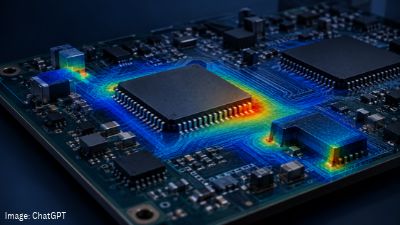
Workshop: PCB Reliability Basics with Ansys Sherlock
This virtual hands-on workshop aims to introduce PCB reliability analysis using Ansys Sherlock, covering ECAD import, component and stackup configuration, and life cycle analysis. Participants will explore solder fatigue, natural frequency, harmonic and random vibration studies, and cumulative damage calculations. Recent capabilities include the Sherlock App in Ansys Mechanical, thermal rainflow cycle counting, thermal-mechanical BGA […]