

Central Michigan University researchers are developing nondestructive evaluation methods that combine ultrasonic measurements, simulation, and AI to detect and locate internal defects in steel pipelines, including corrosion-related wall thinning. Creating large experimental datasets would be costly and time-consuming, so the team uses simulation. Coreform Cubit is used to:
- Create hollow pipe models with internal defects of varying size, shape, and location
- Partition the geometry and generate hexahedral meshes
- Define material blocks and boundaries
Scripting allows the same procedure to be reused, aiming to reduce repeated manual work and keep models consistent. Meshes are exported to SPECFEM3D, which simulates ultrasonic wave propagation and records sensor signals. These signals train a convolutional neural network to predict defect locations.
Overall, the workflow aims to generate reproducible simulation data for AI-enabled pipeline inspection.
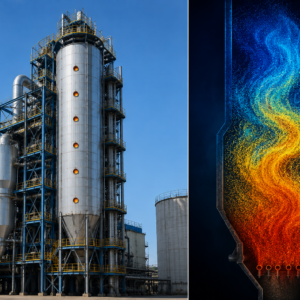
Image generated by: ChatGPT