Breaking the two-hour barrier in a marathon seemed out of reach, but a combination of athletic skill and engineering insight has made it possible. In a recent article, Guilherme Dufflis Fernandes of Florida Polytechnic University explains how simulation helped make sense of drafting, as Sebastian Sawe finished the London Marathon in April below that mark.
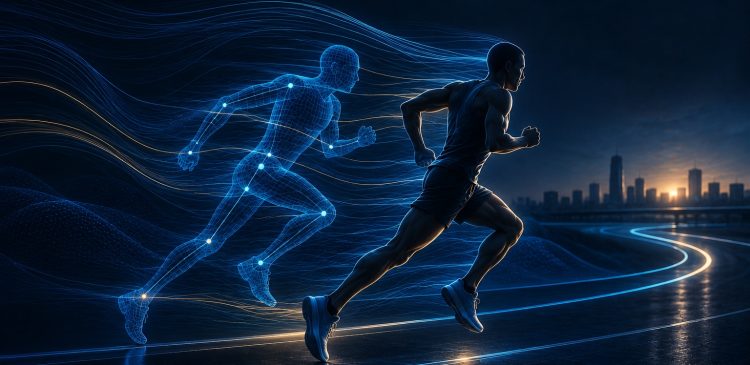
At the centre is drafting, where runners follow pacers to face less air resistance. Researchers used Ansys Fluent fluid simulation software to calculate the drag on a lead runner across a range of pacer formations and speeds. Runner models came from a scaled open-source humanoid figure. The study did not use real-world validation, yet its results were similar to wind tunnel studies. Drag is a small part of total energy use, but it matters when records are at stake. The simulations also showed a trade-off: keeping pacers longer reduces drag, but may need a slower speed.
Eliud Kipchoge’s earlier INEOS run finished under two hours but was not eligible for official records. Applied to his Berlin record run and to Kelvin Kiptum’s unpaced Chicago record, the simulation-guided framework indicated both could have gone below two hours with better pacing.
Sawe’s London run, with pacers present for much of the race, reflects these findings. As simulation lets teams test formations and pacing before race day, it aims to support smarter strategy in future record attempts.
Sahajanand Medical Technologies, a cardiovascular device manufacturer, is deploying Siemens’ Teamcenter software to build a digital thread connecting development, quality and regulatory processes. It aims to improve collaboration, streamline new product development, support global medical device compliance and traceability. Click to read more..
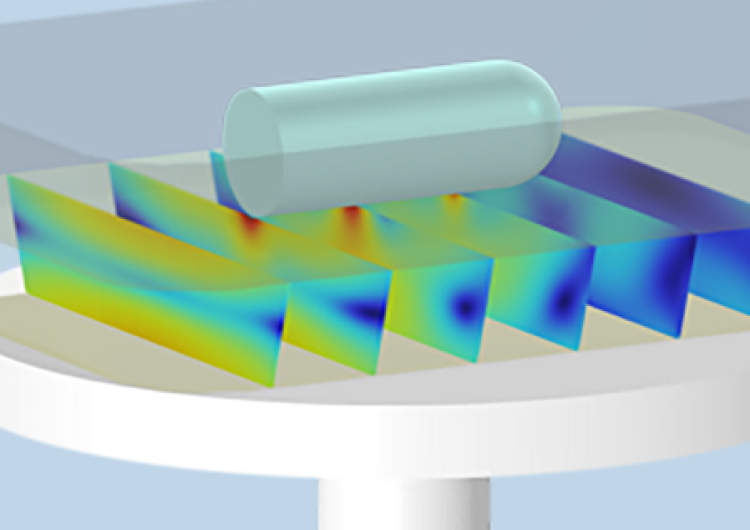
Researchers from GEPEA–Oniris and CTCPA in France used COMSOL Multiphysics to study wireless sensor positioning in microwave-heated packaged food. Aligning the sensor with the microwave direction gave reflected power similar to no sensor, and laboratory measurements agreed with simulations. Click to read more..
ENGYS used computational fluid dynamics (CFD), automated workflows and design optimisation to support Shell’s Triple 10 Challenge concept electric vehicle. The simulation-led approach evaluated vehicle shapes, achieving measurable drag reduction and supporting the programme’s efficiency and lifecycle emissions targets. Click to read more..
Discover what’s new in Keysight CAE Structural Mechanics (VPS) 2026.0, the latest release built to make simulation workflows more efficient and expand modeling capabilities. This webinar walks through key developments across four areas: usability, general updates, material modeling, and compute model updates, aimed at CAE, simulation, and R&D engineers.
Explore what particle number measurements reveal that PM mass alone may miss. This webinar explains how condensation particle counting works, what field data shows about urban pollution and short-term peaks, and how the AVL UltraFine Particle Monitor supports reliable, everyday ambient air monitoring.
This webinar introduces Simulink basics for modeling, simulating, and testing control design for multi-domain dynamic systems. Attendees will learn to build models, design closed-loop PID control algorithms, and analyze simulations, then see how to link requirements to design, verify changes through tests, and generate code for software implementation.
Classical CFD is hitting a performance wall in aerospace, automotive, and maritime applications. This webinar explores how Quanscient and Haiqu ran the first publicly documented quantum simulation of nonlinear fluid flow around a solid object on IBM hardware, using the OSSLBM algorithm with circuit optimization and noise mitigation, and what it means for practical quantum advantage.
Curlscape is a Pune-based AI engineering company with three areas of work: AI products for engineering and simulation teams, infrastructure and data services for enterprises, and custom AI agents for business workflows. Its team combines simulation, CAD, PLM, and manufacturing know-how with production AI engineering.
Solutions & Technology
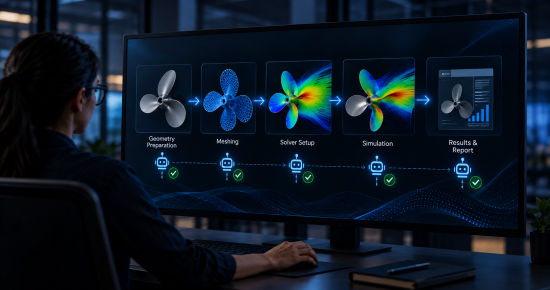
AgentCrew: AI agents for geometry cleanup, meshing, solver setup, and reporting, with review agents gating each stage.
Sift: Surrogate models trained on past simulation data, built to return results in minutes rather than hours or weeks.
Solutions Focus: Curlscape is built on deep simulation engineering experience, and its work centres on making AI dependable for engineering and enterprise use. Rather than replacing the solvers and CAD tools teams already use, it adds automation on top of them, with review agents checking each stage of a workflow. Its systems run on the customer’s own infrastructure, so data and the IP created stay with the customer. In short, Curlscape focuses on AI that is verifiable, practical, and fits into existing engineering environments.
A modern race car is a system of systems, with powertrain, energy storage, cooling, chassis, tires and aerodynamics influencing one another. Yet lap time still depends on the driver, among the hardest elements to simulate. With testing so costly, an inaccurate driver model can weaken predictions for lap time, tire use, energy consumption and setup sensitivity.
PID-based drivers follow a predefined trajectory and speed profile, with limited look-ahead and frequent manual retuning.
Quasi-static tools estimate theoretical limits.
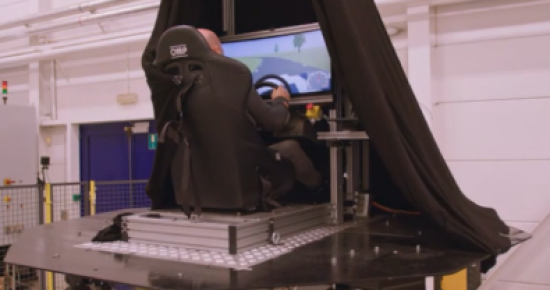
Human-in-the-loop simulators need scarce expert drivers and cannot run quicker than real time.
Its answer, the Simcenter AmesimAdvanced Virtual Driver Model, treats the driver as a human digital twin: an optimization agent working in closed loop with a complete race car digital twin. That vehicle twin covers:
Powertrain, including combustion engine, electric motor, gearbox, inverter, battery and thermal management
Braking with regeneration, suspension, chassis and tires
Aerodynamics and the track environment
Nonlinear Model Predictive Control looks ahead to decide steering, throttle and braking, balancing reference tracking, energy use and lap time within vehicle and track limits. A method called RESAFE/COL is reported to speed up this computation versus state-of-practice MPC methods and allow deployment on target hardware. Autocalibration tunes the driver for each vehicle, track and condition, with validation reportedly extracting up to half a minute from a lap versus the initial reference.
The model also adapted to wet weather by finding a new line for reduced grip, and supports overtaking simulations at very high speeds. With an open, FMI-compatible architecture for offline, real-time and embedded use, it works as a loop: the driver shapes the car, and the car shapes the driver’s next decision.