

Your weekly sync on the pulse of the simulation industry
Industry News
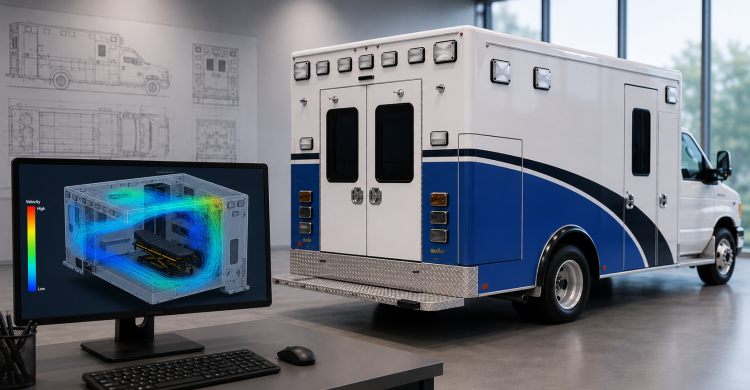
Designing emergency vehicles involves balancing several engineering demands at once, including climate control, structural strength, and vehicle safety, all within tightly constrained interior space. As manufacturers move toward more customized and larger vehicle configurations, simulation software is increasingly being used to evaluate these factors before physical builds begin.
Crestline Coach, an ambulance manufacturer based in Saskatoon, Canada, builds highly customized emergency vehicles with aluminum body construction. The company is now developing a new, larger ambulance model intended for service around FIFA World Cup events in Canada. Because each vehicle is built to specific customer requirements, changes to interior configuration can affect cabin airflow, heat distribution, and structural strength, a recurring challenge for the engineering team.
To address this, Crestline adopted a cloud-based simulation platform from SimScale, using it for both fluid dynamics and structural analysis. For HVAC analysis, engineers used the platform to design an air-mixing system intended to blend hot and cold air for consistent cabin temperatures in extreme winter conditions. On the structural side, the team used simulation to evaluate and refine a bracket supporting a roof-mounted HVAC condenser, addressing vibration concerns identified through analysis.
Crestline says it plans to extend simulation use to areas such as external aerodynamics, HVAC noise mitigation, and battery-powered climate systems as vehicle development continues.
M&A and Partnerships

Dassault Systèmes has signed a definitive agreement to acquire ArisGlobal, an AI-native compliance platform for Life Sciences. The deal aims to combine ArisGlobal‘s regulatory, safety and real-world data expertise with Dassault Systèmes’ modeling and simulation capabilities, creating a unified platform connecting molecule, patient and real-world outcomes.
Keysight Technologies and Rambus have announced a collaboration focused on identifying side-channel leakage in AES (Advanced Encryption Standard) hardware designs during the pre-silicon stage. The approach aims to help semiconductor designers detect potential security vulnerabilities before chip fabrication by using simulation-based analysis alongside traditional FPGA-based hardware testing.
Bramble CFD has partnered with White Motorcycle Concepts (WMC) to support development of its patented V-Duct aerodynamic technology. The collaboration aims to use advanced CFD methods to analyse internal airflow, refine duct designs, and evaluate cooling performance ahead of physical testing.
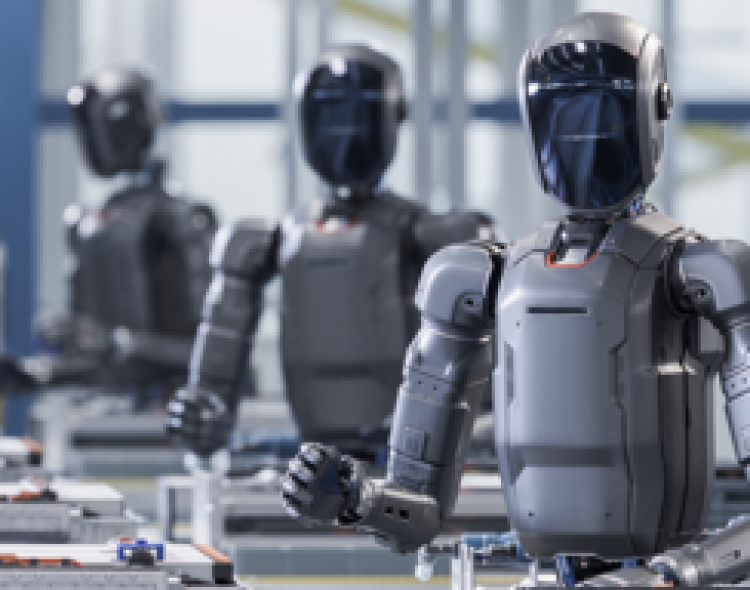
Siemens has highlighted a system simulation approach using Simcenter Amesim to support virtual development of humanoid robots. The platform links mechanics, actuators, power systems, and controls in a digital twin, letting engineers evaluate walking, grasping, and energy use before hardware is built.
Click to read more..
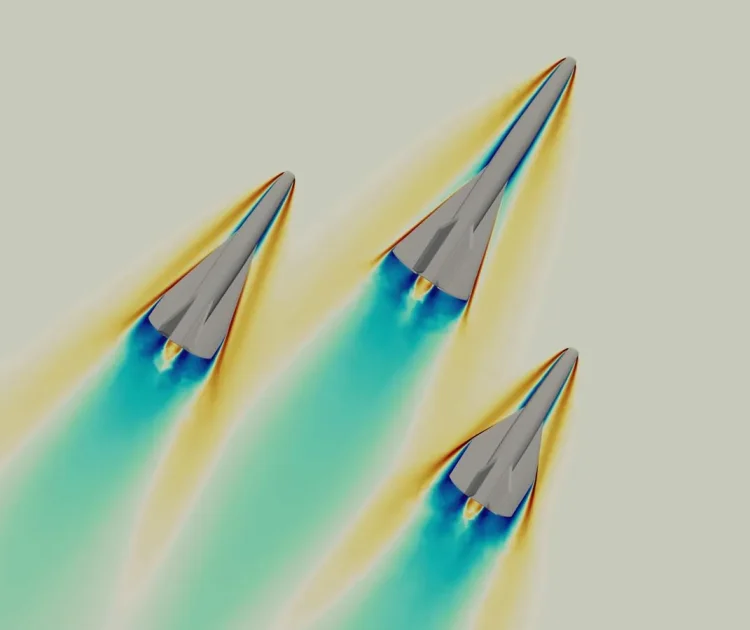
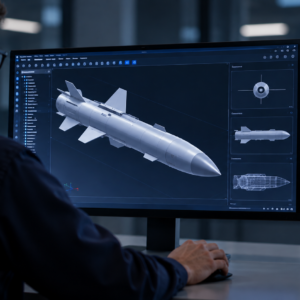
Specter Aerospace worked with nTop to develop a parametric hypersonic vehicle model covering the combustor, duct, and outer mold line. The workflow aims to update geometry based on design parameters, supporting conceptual exploration, detailed engineering, and simulation-ready design processes for defence programs.
Click to read more..
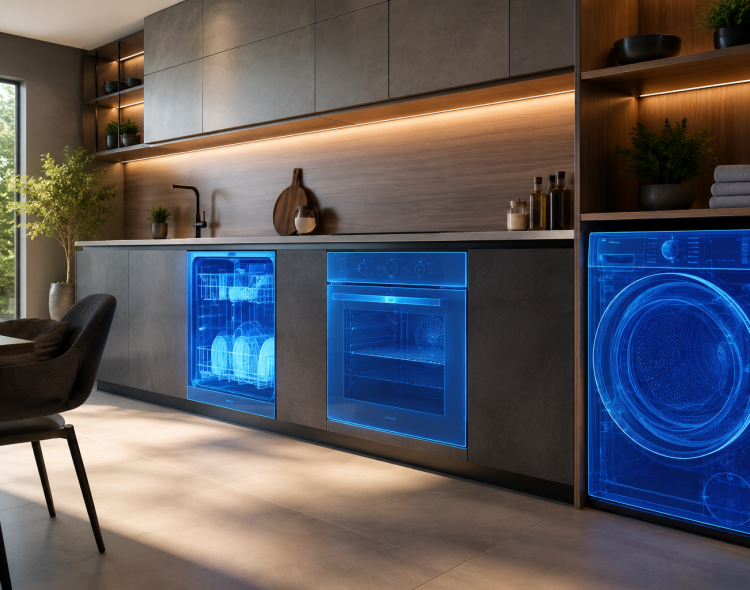
Hisense Europe applies Ansys simulation tools across its appliance range, including washing machines, ovens, induction hobs, and tumble dryers. The approach aims to reduce noise, improve durability, and support sustainability, helping the company cut prototyping needs while advancing appliance performance and design.
Click to read more..
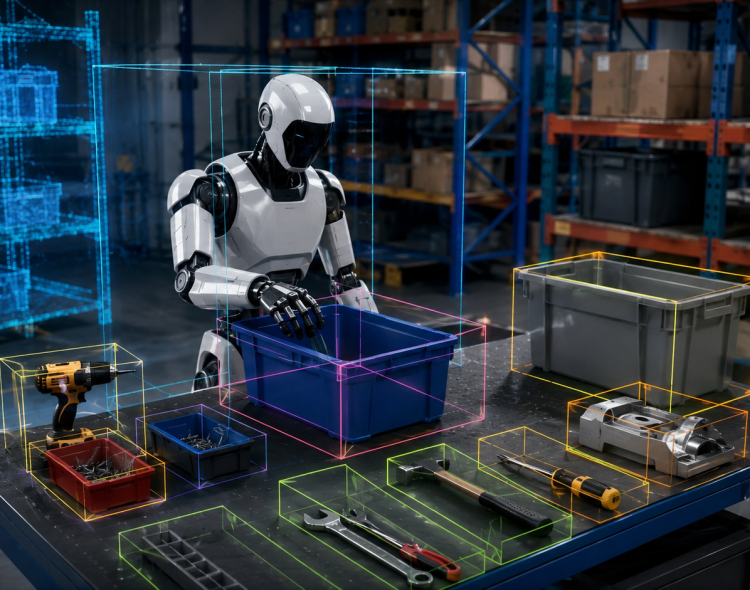
NVIDIA has expanded its Agent Toolkit with Omniverse libraries that aim to help AI agents prepare 3D content for simulation. The libraries, including ovrtx for sensor simulation, ovphysx for GPU-accelerated physics simulation, and CAD-to-SimReady skills for converting CAD data into simulation-ready OpenUSD assets, are openly available on GitHub.
Click to read more..
Industry Events
This webinar covers COMSOL Multiphysics® modeling capabilities for HVAC and building performance applications, including conjugate heat transfer, moisture transport, and solar radiation. Live demonstrations will show airflow through duct and piping networks, temperature and humidity distribution prediction, and how contaminant leaks spread through buildings and HVAC duct systems.
📅 August 4, 2026
🕚 11:00 – 12:00 EDT
This webinar introduces teachers and mentors to Ansys Discovery for STEM Racing, demonstrating how real-time simulation supports aerodynamic analysis, design optimisation, and performance evaluation. Participants will also learn how to integrate simulation into the design–test–make workflow and access classroom-ready learning resources.
📅 August 4, 2026
🕚 11:00 – 12:00 EDT
This conference brings together automotive engineers, researchers, and industry experts to explore the latest trends in Model-Based Design, AI, and virtual engineering. Attendees will gain insights into MATLAB® and Simulink® advancements, customer success stories, hands-on technology showcases, and applications spanning ADAS, software-defined vehicles, and electrification.
📅 August 5, 2026
🕣 8:30 – 16:45 IST
📍 The Westin Pune Koregaon Park, Pune
This webinar explores how Physics AI accelerates digital twin development for aerospace and defence, demonstrated through SHIFT-Missile, a surrogate model predicting missile aerodynamics and structural mechanics. Attendees will learn how rapid aero-structural predictions support design optimisation, continuous model correction, as well as CFD-agreement performance insights, and faster engineering decision-making while reducing test cycles and programme risk.
🎥 Available On Demand
In FOCUS
Company in Focus
Who they are
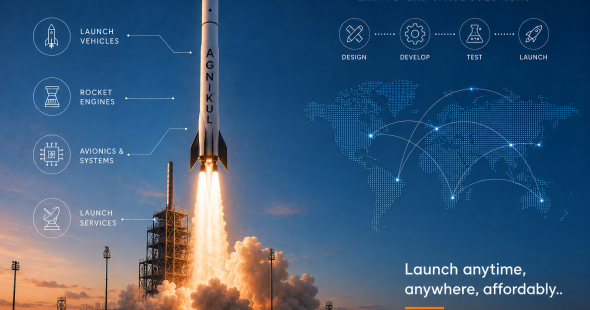
Agnikul Cosmos is a Chennai, India-based full-stack orbital launch vehicle company, founded in 2017, that began operations out of the National Center for Combustion R&D at IIT Madras, with a second facility under Agnikul Cosmos Launch Vehicles Pvt Ltd in Thiruvananthapuram, Kerala. The company designs and manufactures configurable, orbital-class launch vehicles built around 3D-printed engines.
Solutions & Technology
The company’s technology is built around a fully in-house engineered launch stack, from propulsion to ground infrastructure:
- Agnilet Engine: The world’s first single-piece, fully 3D-printed semi-cryogenic rocket engine, delivering 6.2kN of thrust and powering both vehicle stages.
- Agnibaan: An indigenous, orbital-class launch vehicle designed to deliver small satellites to Low Earth Orbit (LEO) on demand, with a mass of 490 kg and LEO capability around 680 km, plus an optional “baby stage” inside the payload fairing.
- Dhanush: A fully mobile launch system comprising transportable LOX and ATF storage, a movable launch pedestal, and a Mission Control Centre, enabling launches from any suitable geographic location.
- In-house Avionics & Autopilot: Modular, self-designed flight systems built to adapt across vehicle configurations.
Applications:
Agnikul’s configurable vehicle architecture is designed to serve two distinct mission needs:
- Dedicated Small-Satellite Launches: Agnibaan avoids rideshare delays, offering payload-sized, on-demand missions.
- Sub-orbital Testing: SOrTeD, a standalone sub-orbital vehicle carrying payloads up to 30 kg, supports near-space experimentation up to the 90 km Karman line.
Did you know?
On May 30, 2024, Agnibaan SOrTeD‘s Mission-01 lifted off at 0715 hrs from Agnikul Launchpad-01, India’s first private launchpad, at SDSC SHAR, Sriharikota.”
Solutions Focus
Agnikul‘s overarching mission is to make space transportation configurable, reliable, and accessible—sizing each vehicle to the customer’s payload so they pay only for what they launch, while its mobile launch infrastructure solves for last-mile orbital connectivity. This flexibility underpins the company’s core promise: to launch anywhere, anytime, affordably.
Technology Focus
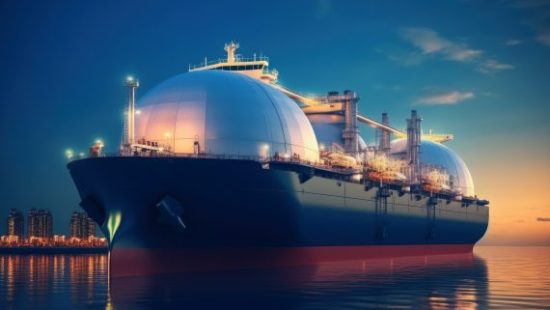
The maritime industry is under increasing pressure to reduce fuel consumption and emissions while meeting evolving environmental regulations. LNG carriers face a unique challenge in this shift, as they must manage propulsion, electrical power, thermal systems, and cargo simultaneously. During transport, some liquefied natural gas naturally evaporates into boil-off gas, which can be used as fuel, consumed in boilers, re-liquefied, or safely disposed of, each choice influencing efficiency differently.
A blog by Gamma Technologies highlights how these interconnected systems make isolated optimization ineffective, and how system-level simulation can offer a clearer picture of vessel performance.
Using GT-SUITE, engineers build integrated models that combine:
- Main propulsion and dual-fuel engines
- Auxiliary generators and power distribution
- Boilers, steam networks, and waste heat recovery
- Reliquefaction and gasification systems
- Hull performance under real voyage conditions
This approach allows engineers to simulate voyage profiles under varying speeds, cargo conditions, weather, and load demands, turning simulation into a decision-support tool rather than just a design exercise.
In one study, simulation revealed that auxiliary generators often ran at low loads, reducing efficiency. Consolidating loads onto fewer engines running at higher utilization improved efficiency without any hardware changes.
Interestingly, this suggests that meaningful progress toward maritime decarbonization may not always require new fuels or equipment. Smarter operational strategies, guided by system-level simulation, aims to reveal efficiency gains already present within existing vessel designs.