


From global regulations to safer battery design
One Battery, Different Rulebooks
EV batteries are being asked to do more. Faster charging, longer driving range, higher energy density and lower weight continue to push battery development forward. But every improvement in performance has to coexist with an equally important requirement: safety.
For engineers, demonstrating that safety is becoming a complex challenge. An EV developed for a global market does not encounter a single regulatory framework. India addresses EV battery safety through requirements such as AIS-038 (Rev.2), while UN Regulation No. 100 (UN R100) provides rechargeable energy storage system safety requirements for countries applying the UNECE framework. Within Europe, relevant UN regulations such as UN R100 form part of the vehicle type-approval landscape, while Great Britain operates its own type-approval framework that also recognizes applicable UN regulations. China has further strengthened its battery safety requirements through GB 38031-2025. In the United States, FMVSS 305a expands propulsion-battery safety requirements, with mandatory applicability beginning in 2027 for light vehicles.
While international harmonization is bringing many safety requirements closer together, the regulatory pathways are not identical. Differences remain in areas such as test procedures, applicability and compliance requirements.
Yet many of the underlying engineering concerns are common:
- What happens if thermal runaway begins in one cell?
- Can it spread through the pack
- How does the battery respond to mechanical damage?
- Can its electrical protection remain effective under abnormal conditions?
- And how does the system behave under demanding environmental conditions?
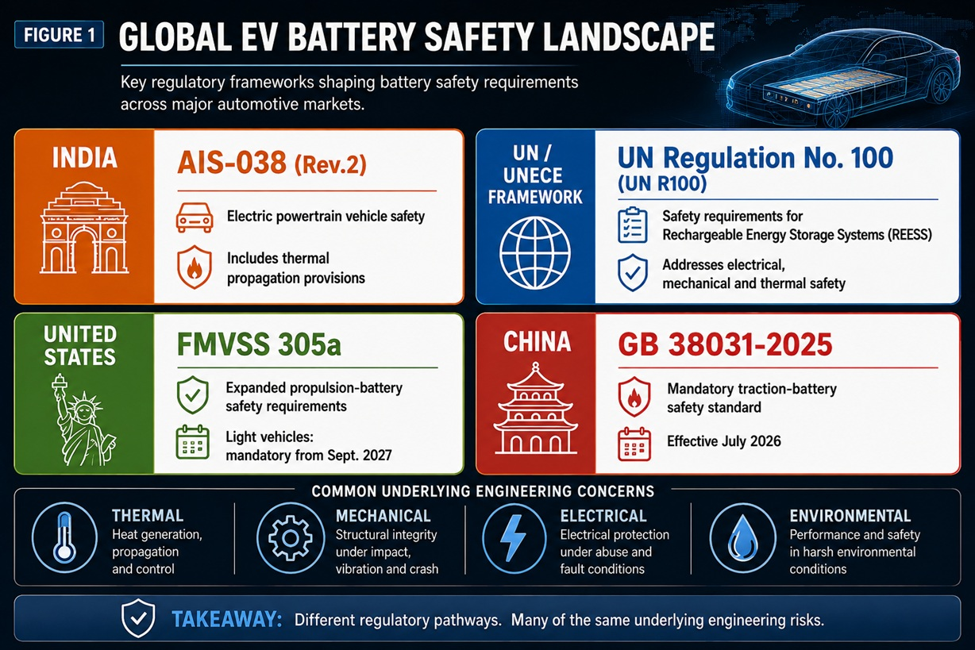
These are not simply regulatory questions. They are design questions.
Regulations prescribe conditions under which battery safety has to be demonstrated. But engineers designing the battery need to understand what is happening inside the system under those conditions: where heat travels, where structures deform, where electrical or thermal vulnerabilities may develop, and which design changes could reduce the risk.
This distinction becomes particularly important as a design approaches physical validation. Battery safety testing can require packs, subsystems or complete vehicles, specialized facilities and, in some cases, destructive tests. If a significant weakness emerges late in this process, resolving it may require more than simply repeating the test—it can send engineers back into the design.
So, there is an important question to ask before the battery reaches the test facility:
Can engineers identify potential safety problems while they still have the freedom to change the design?
From a Safety Requirement to an Engineering Problem
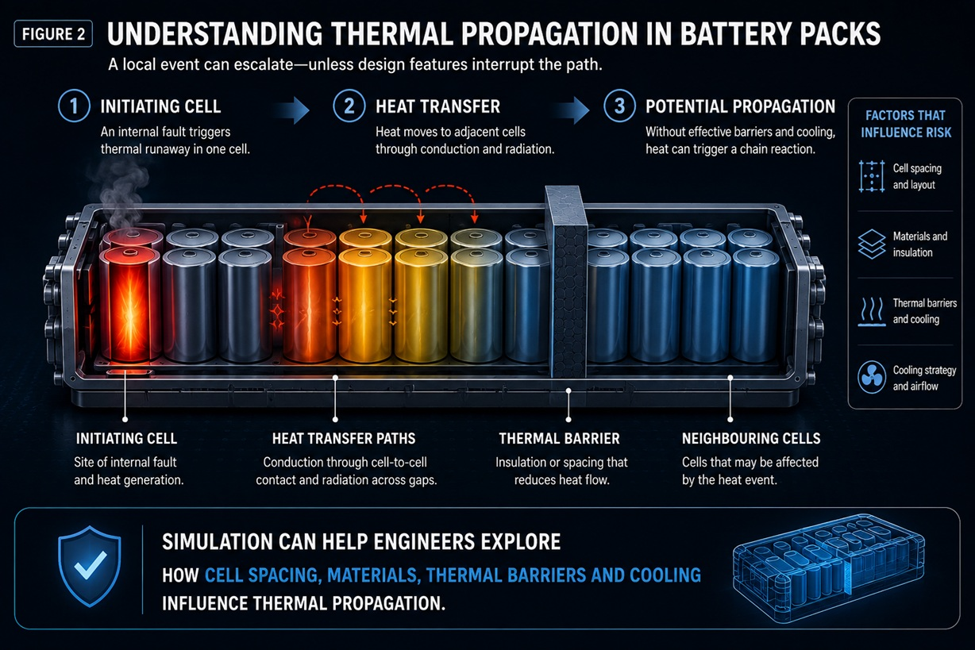
Consider thermal runaway. A failure may begin in a single cell, but for the engineer, the more important question is what happens next. Does the heat remain localized, or does it trigger neighboring cells? How quickly does the event develop? Can the battery architecture slow or contain its propagation?
This is where a regulatory requirement becomes an engineering problem.
Thermal propagation has become an important consideration in battery safety requirements across markets. India’s AIS-038 (Rev.2), for example, includes requirements addressing thermal propagation, while China’s GB 38031-2025 has strengthened requirements concerning battery behavior following a thermal event.
But knowing the required outcome is only part of the problem. Engineers need to determine what design will achieve it.
Cell spacing, thermal barriers, cooling arrangements, enclosure design and material selection can all influence how heat moves through a battery pack. Changing one of these may improve thermal protection, but it may also affect weight, packaging, manufacturability, cost or overall battery performance. Safety therefore becomes one of the variables shaping the design itself.
The same principle applies to mechanical safety. Under vibration, impact or crush conditions, engineers need to understand where deformation occurs, how loads travel through the pack and whether vulnerable cells or electrical connections could be affected.
Electrical abuse and environmental exposure add further interactions. Overcharge, short circuits, temperature extremes or water exposure can involve electrical, thermal and structural behavior simultaneously.
A regulatory test defines the condition a battery must withstand and the criteria it must satisfy. The engineering question goes further:
What happens inside the battery as that event unfolds—and what can be changed before the design is committed?
That is where virtual testing begins to become interesting.
From Physical Tests to Virtual Exploration
Simulation allows engineers to investigate how a battery is likely to behave under prescribed test conditions before physical testing begins.
Regulatory test conditions can often be translated into simulation inputs—thermal loads, mechanical forces, vibration profiles or electrical operating conditions. Engineers can then examine the predicted response and explore design alternatives.
For thermal propagation, simulation can help examine how heat travels between cells and whether changes in spacing, thermal barriers, cooling or materials could slow its spread. Structural models can identify deformation, stresses and vulnerable load paths under vibration, impact or crush conditions. Multiphysics approaches can go further by investigating interactions between thermal, structural and electrical behavior.
But does this mean an engineer can simply select a regulation from a software menu and receive a compliance result?
Not quite.
Simulation platforms increasingly provide battery-specific models, specialized safety workflows and methods for reproducing standardized test conditions. However, regulatory compliance is not reduced to a universal ‘pass’ button. The relevant requirements still have to be translated into appropriate loads, boundary conditions, material behavior and assessment criteria.
Simulation is therefore less a digital compliance checklist and more an engineering exploration tool.
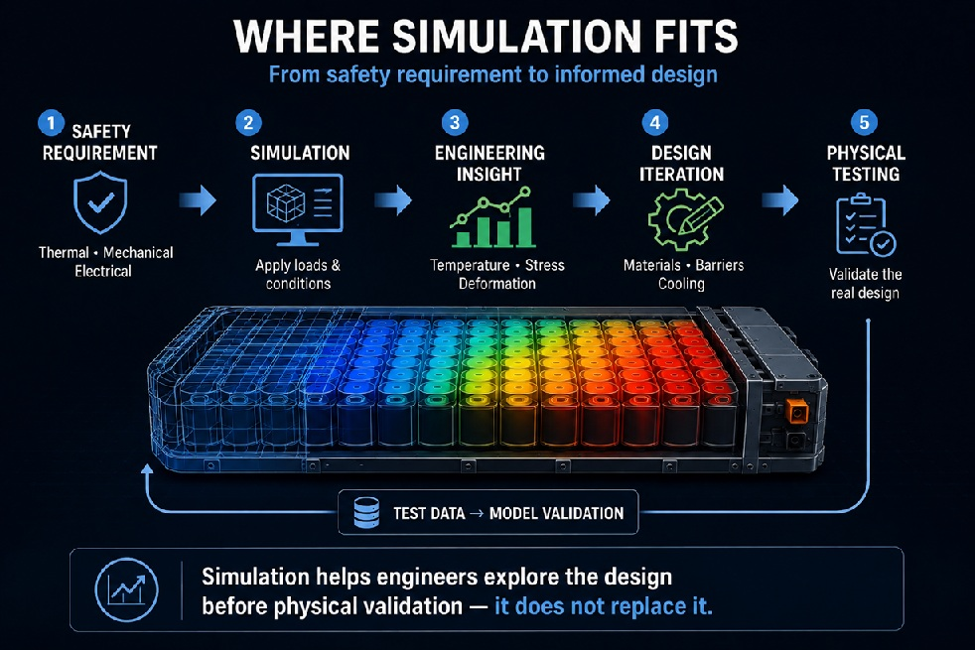
A prescribed physical test can establish whether a particular design satisfies its defined criteria. Simulation can help engineers understand why the battery behaves as it does, identify potential vulnerabilities and investigate possible design changes earlier.
Its value lies not in predicting a certificate, but in helping engineers arrive at physical testing with a better-informed design.
Simulation Is Not Certification
For all that simulation can reveal, a virtual battery remains a model of the real one.
Its predictions depend on the quality of the underlying data and assumptions—material properties, cell chemistry, state of charge, thermal behavior, boundary conditions and the way failure mechanisms are represented. Real batteries also introduce manufacturing variation, ageing and behaviors that may be difficult to capture completely.
Thermal runaway illustrates this particularly well. It can involve heat transfer, electrochemical reactions, gas generation, venting, structural changes and combustion. Capturing every interaction accurately is difficult, which is why simulation models need experimental calibration and validation.
Physical testing therefore remains essential. It provides evidence for validating models and, where required, demonstrating that the actual battery or vehicle satisfies prescribed regulatory criteria.
The relationship is not:
Simulation instead of testing.
It is closer to:
Simulation to explore → physical testing to validate → learning to improve both the model and the design.
Used this way, simulation allows engineers to investigate alternatives and potential weaknesses before the design reaches final physical validation.
As battery performance continues to advance and safety requirements evolve, perhaps the more useful question is no longer whether simulation can replace physical testing.
It is how much engineers can afford to leave undiscovered until physical testing begins.
Conclusion
EV battery safety is increasingly shaped by a combination of evolving regulations, complex physical behavior and the need to make design decisions earlier in the development process.
Across markets, the regulatory frameworks may differ, but the underlying engineering questions are often similar: how a battery responds to thermal, mechanical, electrical and environmental stresses, and whether those risks can be controlled before they become failures.
Simulation cannot certify a battery, nor can it replace physical validation. What it can do is help engineers explore those risks earlier, test more design alternatives and understand why a particular design may be vulnerable.
That may be its most important role in EV safety engineering: not replacing the final test but helping ensure that fewer surprises are left for it.
References
- ARAI / Ministry of Road Transport & Highways, Government of India — AIS-038 (Rev.2): Specific Requirements for M and N Category Electric Power Train Vehicles.
- UNECE — UN Regulation No. 100 (UN R100): Uniform provisions concerning the approval of vehicles with regard to specific requirements for the electric power train.
- U.S. National Highway Traffic Safety Administration (NHTSA) — FMVSS No. 305a: Electric-Powered Vehicles — Electric Powertrain Integrity.
- State Administration for Market Regulation (SAMR), China — GB 38031-2025: Electric Vehicles Traction Battery Safety Requirements.
- Feng, X. et al. — “Thermal runaway mechanism of lithium-ion battery for electric vehicles: A review.” Energy Storage Materials, 2018