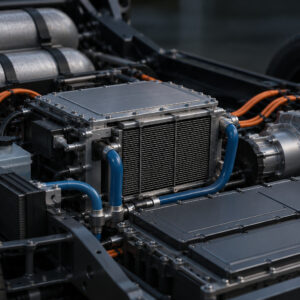


Hydrogen is a promising fuel with high energy content per kilogram, but it is hard to store and move. It leaks easily, can embrittle metals, and ignites with very little energy. Since physical testing is slow, costly, and sometimes hazardous, Convergent Science describes how its software, CONVERGE, aims to enable virtual design testing.
Production and storage
Most hydrogen still comes from natural gas reforming; pyrolysis and electrolysis are scaling up. For pyrolysis, the software aims to predict methane-to-hydrogen conversion.
Compressed tanks must manage temperature rise while filling; the company reports its predictions matched experiments.
Liquid hydrogen tanks exchange heat and mass between liquid and vapor; modeling aims to capture this and predict boil-off.
Transport
Hydrogen’s lower energy by volume means pipelines need higher velocities or pressures; simulation aims to evaluate pressure drop, temperature changes, and leaks in blended gas.
In trailers, sloshing can accelerate boil-off; in pumps, liquid-vapor shifts can cause cavitation. Simulation aims to guide tank design and flag pump risks early.
Safety
Hydrogen ignites across a far wider concentration range than methane. Simulation aims to show how leaks disperse, informing sensor and ventilation planning. It also covers self-ignition, bonfire tests, flame arrestors, and deflagration-to-detonation transition.
End use
CONVERGE is used for hydrogen engine strategies, including direct injection and dual-fuel, and for fuel cell performance. Hydrogen is also entering heating and industrial uses.
From production to end use, every stage of hydrogen’s journey presents distinct challenges. Simulation aims to help engineers understand these risks early, supporting the safe and practical growth of the hydrogen ecosystem.
Click to read the original article..
Image generated by: ChatGPT