

Fish ladders are structures that help migrating fish pass over or around obstacles such as dams, culverts, and waterfalls. Designing them is challenging because water velocity, flow, and turbulence may need adjustment for each fish species, age group, and site, while budget, regulatory, and time limits also apply.
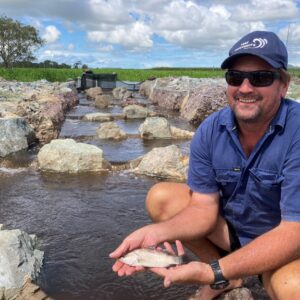
One example comes from a coastal ponded pasture restoration project in Central Queensland, Australia. Catchment Solutions LLC of Mackay worked with Brisbane-based Forward Hydro to develop a rock ramp-style fishway that aims to improve connectivity between saltwater habitats and freshwater wetlands, which many fish species travel between during their life cycles.
The fishway needed to cross a drop at the wetland outlet, so a natural rock ramp with lateral ridges and pools was used. Between pools, a nursery slot of staggered steps, each slightly lower than the next, aims to provide a shallow film of flow, while rough concrete forms lower-velocity zones for weaker swimmers.
Forward Hydro used CFD modeling, through FLOW-3D HYDRO, to assess the hydraulic performance of this innovative design. A larger model examined flow across multiple pool sections, while a finer model studied the nursery slot against fish burst speed, burst length, and critical swim speed.
Simple meshing let the team capture rock and slot details without reconfiguring the mesh each time. Monitoring reported by Catchment Solutions showed many fish, including postlarvae and juveniles, ascending the fishway. Insights from the modeling may guide future designs, showing how engineering and ecology together can open pathways for even the smallest fish.
Image courtesy: Flow Science