

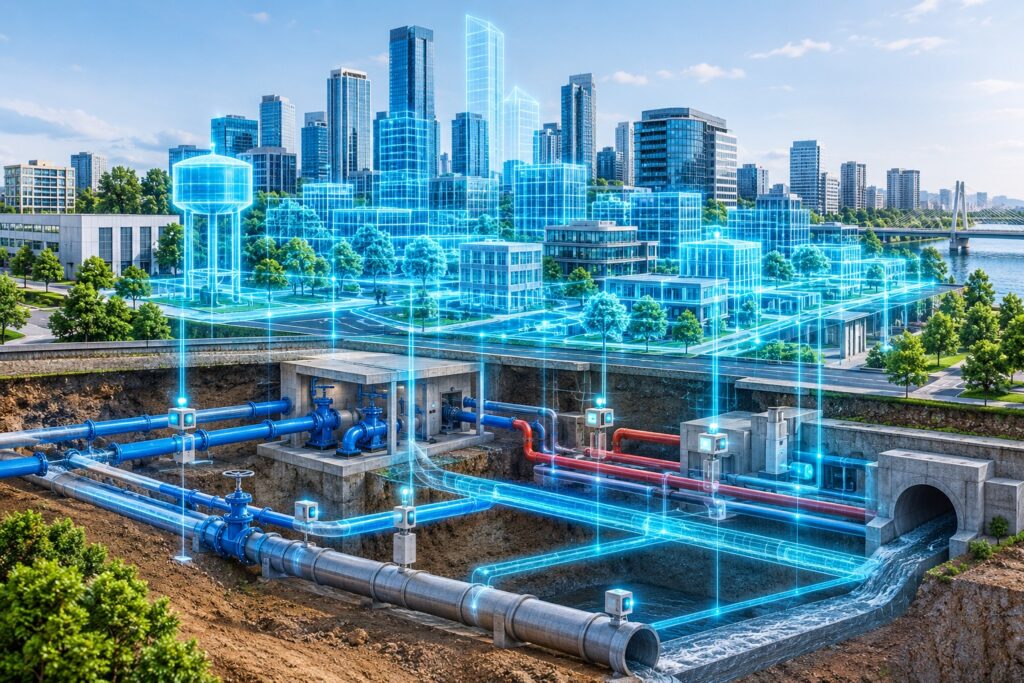
A digital twin in infrastructure is a continuously updated, physics-based model of a real network, such as water distribution, district energy, sewer, or stormwater systems. As explained by Fluidit, it aims to help utility operators and engineers simulate system behavior, test scenarios before implementation, detect anomalies early, and support both daily decisions and long-term planning.
It combines the model, which encodes pipe diameters, pump curves, valve settings, and network connections along with the equations describing flow, pressure, and temperature; the data from sensors, meters, and control systems that keeps it current; and an interface for running scenarios and viewing results. Unlike a conventional simulation model, which is usually built for a defined question and then set aside, a digital twin stays connected to the real system.
Common uses include operational monitoring, scenario simulation, failure forecasting, capital investment planning, and regulatory reporting. Water utilities may use it for pressure zone management and leakage detection, district energy operators to model thermal behavior, and sewer operators to anticipate combined sewer overflow events. It also creates an auditable record of system state and decisions.
Building one requires network asset data, operational data for calibration, and boundary condition data such as demand, rainfall, and source temperatures. Utilities typically progress from a calibrated model, to a regularly updated one, and then to real-time connection when decisions need a current picture of the system.
Click to read the original article..
Image generated by: ChatGPT