


Electric vehicles are entering a different phase of engineering development.
The challenge is no longer centered on improving individual technologies alone. Better batteries, safer systems, smarter software and faster validation remain important, but increasingly, progress depends on how effectively these technologies work together.
A change in battery performance can alter thermal behavior. Thermal behavior influences safety and control strategies. More sophisticated controls increase the role of software, while growing software complexity changes how vehicles need to be developed and validated. Simulation and physical testing, once viewed as distinct stages of development, are increasingly becoming part of a continuous engineering process.
The result is an EV that is not simply becoming more advanced, but more interconnected.
Over the course of this series, we have explored several parts of this changing landscape — batteries and safety regulations, digital twins and software-defined vehicles. Viewed together, they reveal a broader shift: progress in one area increasingly depends on progress in another.
That shift is also changing the engineering ecosystem around the vehicle.
Automakers remain central, but they are working alongside battery specialists, suppliers, testing and homologation organizations, simulation and software companies, research institutions and emerging technology firms. Their roles increasingly overlap because the engineering problems themselves overlap.
A battery digital twin, for example, can connect battery behavior, thermal conditions, operating data and software. Physical safety tests can generate data that improves simulation models. Virtual ECUs can allow software development and validation to begin before the corresponding hardware is available.
The technologies are converging. So are the engineering disciplines behind them.
Looking at the organizations working across this ecosystem therefore offers another way to understand where EV engineering is heading — not through a catalogue of companies or technologies, but through the engineering problems they are trying to solve.
The Battery Beyond the Laboratory
Battery development does not end when a cell chemistry is selected or a pack is designed. Some of the most difficult engineering questions emerge later, as thousands of cells begin accumulating kilometers, charging cycles and exposure to very different operating conditions.
Two apparently identical batteries may not age in exactly the same way. Temperature, charging patterns, driving behavior and operating loads all influence degradation. Over time, differences can also emerge between individual cells within the same pack.
This is shifting attention towards another part of battery engineering: understanding how batteries behave in real-world use.
Fawkes Energy is one of the younger companies working in this area. Rather than developing a new cell chemistry, its work combines physics-based battery models, operational data and machine learning to estimate battery health and remaining useful life and identify abnormal behavior. The approach is particularly relevant for EV fleets, where batteries operating across many vehicles can generate large amounts of data but may also experience very different usage patterns.
The engineering challenge is not simply collecting more data. Battery behavior is complex, and purely data-driven models may struggle when operating conditions move beyond those represented in their training data. Combining physical understanding of battery behavior with information gathered in operation offers another way of interpreting what is happening inside the pack.
Larger automotive and technology organizations are exploring the same broader challenge from different directions. Work by General Motors, for example, has examined cell-level battery modelling that accounts for differences developing between cells as packs age. Tata Motors and Tata Technologies have explored predictive approaches for estimating battery health and identifying early indications of thermal runaway.
Together, these developments point towards a subtle but important change.
Battery management is moving beyond measuring what the battery is doing towards understanding why its behavior is changing and what may happen next.
That matters for more than range or battery life. A better understanding of degradation can inform charging and thermal management strategies. Identifying abnormal behavior earlier can support safety. Knowledge gained from batteries operating in the field can also feed back into models, testing and ultimately future battery designs.
The battery is therefore becoming not only an energy-storage system, but an increasingly observable and interpretable engineering system.
And as engineers try to predict its behavior more accurately, another question becomes unavoidable: how do we establish that those predictions and the systems built around them remain reliable when conditions become extreme?
That takes us from understanding battery behavior to testing its limits.
From Physical Validation to a Living Virtual Model
Predicting battery behavior is valuable, but safety ultimately has to be demonstrated under conditions that engineers hope a vehicle will never encounter.
This is where regulation becomes engineering practice.
At RISE Research Institutes of Sweden‘s SEEL Swedish Electric Transport Laboratory (SEEL), batteries are subjected to electrical, mechanical and thermal abuse, fire and thermal-propagation testing. Tests can examine not only whether a system meets a requirement, but how a failure begins, whether it remains localized and how the surrounding system responds.
Such physical testing remains indispensable. But the data it produces has another value: it can help engineers check, refine and improve the models being used to represent the physical system.
That relationship is becoming increasingly important as digital twins move beyond conventional simulation.
A simulation typically helps engineers answer a defined question about a system under particular conditions. A digital twin goes further by maintaining a connection between the physical system and its virtual representation through data. As that connection develops, the model can evolve with the system it represents rather than remaining fixed at the design stage.
For EV engineering, this opens up possibilities across development and operation.
A virtual representation of a battery can be updated with information about temperature, charging behavior and degradation. Models of the powertrain or vehicle can be compared with physical test results. Once vehicles enter service, operating data can help engineers understand whether assumptions made during development continue to reflect what is happening in the real world.
The technology is also becoming more accessible beyond the largest vehicle manufacturers. In India, Automotive Research Association of India (ARAI) ‘s Digital Twin Laboratory has been established as a hub-and-spoke facility intended to support OEMs, MSMEs and startups with simulation-led development and virtual validation. Its capabilities extend into Hardware-in-the-Loop testing, where battery-management systems, motor-control units and vehicle-control units can interact with simulated representations of the systems they are expected to control.
Elsewhere, engineering organizations are extending the idea further into vehicle development. FEV India Pvt Ltd for example, has demonstrated digital-twin approaches for vehicle energy management, connecting models with real-world driving and vehicle data to investigate energy consumption and optimize control strategies.
What links these applications is not simply the creation of a more detailed virtual model. It is the feedback between virtual and physical engineering.
Models help determine what should be tested. Physical tests expose where models need improvement. Operating data reveals behavior that may not have been anticipated during development. Updated models can then help engineers investigate that behavior without recreating every condition physically.
The development process begins to look less like a sequence of separate stages and more like a continuous loop between model, test, data and refinement.

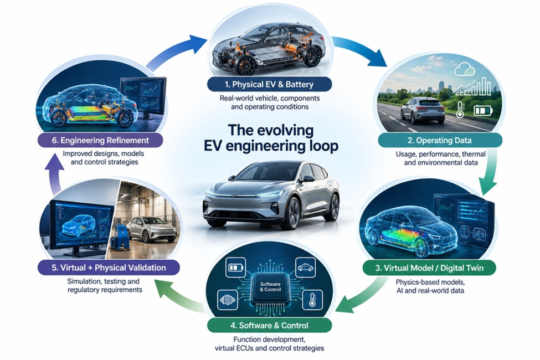
And as more vehicle functions move into software, that loop becomes even more important. Engineers increasingly need virtual representations not only of batteries and powertrains, but of controllers, networks and complete vehicle systems — sometimes before the corresponding hardware exists.
That is where the digital twin begins to meet the software-defined vehicle.
When the Vehicle Becomes a Software Platform
As more vehicle functions are defined by software, the development challenge changes again.
Software for energy management, charging, diagnostics, driver assistance and vehicle control must interact reliably with sensors, controllers, networks and physical systems across the vehicle. And unlike hardware, software continues to evolve after a vehicle has entered production.
This is one reason the software-defined vehicle is changing not only what goes into a vehicle, but how the vehicle itself is engineered.
Waiting for every physical ECU and prototype vehicle to become available before software integration begins can slow development considerably. Virtual ECUs and Software-in-the-Loop environments allow parts of that work to begin earlier, while Hardware-in-the-Loop systems progressively introduce real controllers and hardware into the validation process.
Tata Elxsi‘s work with Suzuki Motor Corporation illustrates this shift. Their cloud-enabled HIL center allows engineering teams to access vehicle-level validation infrastructure remotely and test software with actual ECUs. Tata Elxsi’s collaboration with Synopsys extends the approach through virtual ECUs, enabling software development and testing before all the corresponding hardware is available.
FEV India Pvt Ltd and KPIT TECHNOLOGY are approaching similar challenges through virtual engineering environments that bring software development, simulation and continuous validation closer together. The objective is increasingly to identify integration problems while the vehicle is still evolving rather than waiting until complete prototypes arrive.
But SDVs also raise a larger question of scale. As software architectures become more complex, repeatedly developing every underlying software layer independently can consume significant engineering effort. Initiatives such as the Eclipse Software Defined Vehicle ‘s S-CORE project bring automotive and technology organizations together around an open-source core software stack for SDVs; an example of collaboration becoming part of the engineering response itself.
Seen from this perspective, the developments explored throughout this article are not isolated.
Fawkes Energy’s work on understanding batteries in operation, RISE’s physical safety testing, ARAI’s virtual validation infrastructure and the move towards virtualized software development all address different problems. Yet each reflects the same broader change: EV engineering is becoming more connected, more data-informed and more iterative.
The boundaries are beginning to blur. Battery behavior informs software. Physical tests improve models. Models help determine what needs to be tested. Virtual controllers allow software to develop ahead of hardware. Data from operating vehicles can return to the engineering process.
No single company, technology or engineering discipline owns that cycle.
The progress of electric mobility will still depend on advances in batteries, safety, simulation and software. But increasingly, it will also depend on the ecosystem connecting them; the automakers, suppliers, startups, testing organizations, research institutions and engineering technology companies contributing different pieces of the same problem.
That is the larger story behind this EV series.
The individual technologies matter. But as the electric vehicle evolves, some of the most important engineering progress may come from how effectively those technologies, and the organizations developing them, learn to work together.
Images generated by: ChatGPT