


Returning humans to the Moon involves more than rockets and landings—it also requires solving challenges astronauts may face once they step onto the lunar surface. As NASA advances its Artemis missions, the space agency is working with industry specialists to prepare for long-term lunar exploration. As part of these efforts, NASA selected Synopsys and Electro Magnetic Applications, Inc. (EMA) to study how the Moon’s harsh environment could affect astronaut spacesuits and communication systems.
NASA’s Johnson Space Center selected the two companies to examine charging effects on Artemis spacesuits caused by lunar regolith, or Moon dust, and the surrounding plasma environment. These conditions can create electrostatic charge on suit surfaces, which may lead to electrostatic discharge and disrupt electronics used for life support and communications.
To assess these risks, Synopsys and EMA plan to use Ansys Charge Plus. The software will evaluate spacesuit materials, layered structures, and design features under lunar plasma conditions. The work will be supported by testing at EMA’s SERE Laboratory in Massachusetts.
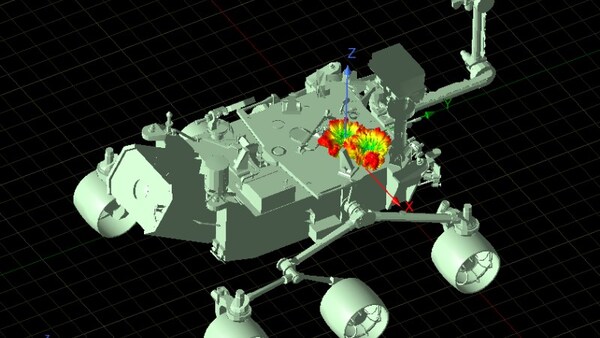
Synopsys, Cesium, a part of Bentley Systems, and NASA’s Glenn Research Center are addressing another lunar challenge: reliable surface communications across uneven terrain. Using Cesium’s digital twin lunar terrain models with Ansys RF Channel Modeler and Ansys HFSS, the teams are studying radio signal coverage and antenna performance for spacesuits and rovers, with the aim of helping shape future cellular communication networks on the Moon.
Click to read the original article..
Image courtesy: Synopsys