


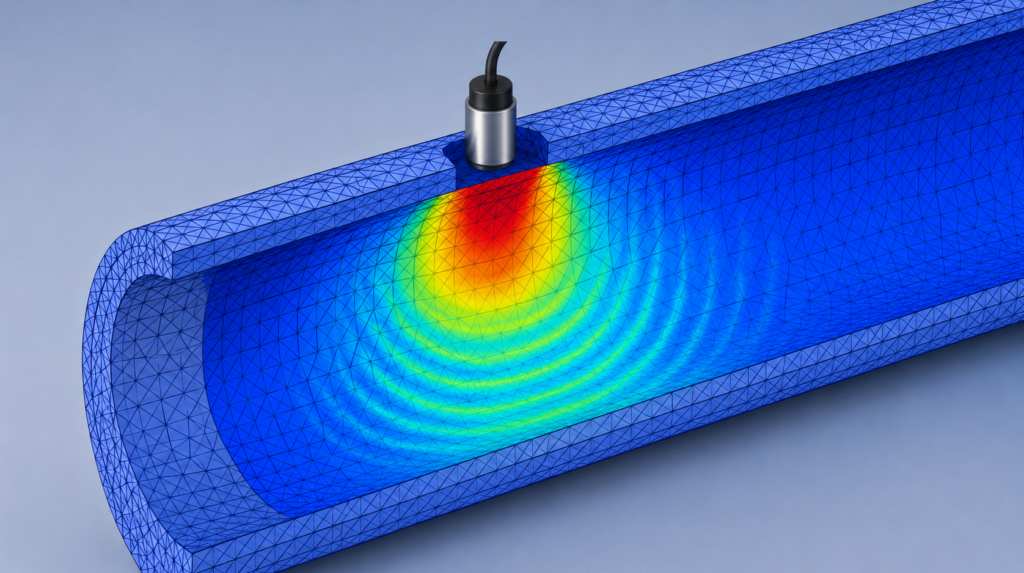
A researcher from Acoustics Group at SINTEF has presented an approach for modeling pulse-echo ultrasonic measurements used in the oil industry to evaluate conditions behind pipes, including cement quality, shale bonding, and fluid-filled gaps. As full three-dimensional simulations are computationally demanding because of high-frequency ultrasonic waves and complex geometry, the study explores a two-dimensional axisymmetric model aligned with the transducer’s symmetry axis.
The approach aims to preserve the essential wave propagation behavior while supporting broader parametric studies. Using COMSOL Multiphysics with LiveLink for MATLAB, the team generated a simulation database covering variations in pipe geometry, material properties, and transducer distance to support the interpretation of pulse-echo measurements and reduced-order modeling research.
Image generated by: ChatGPT