


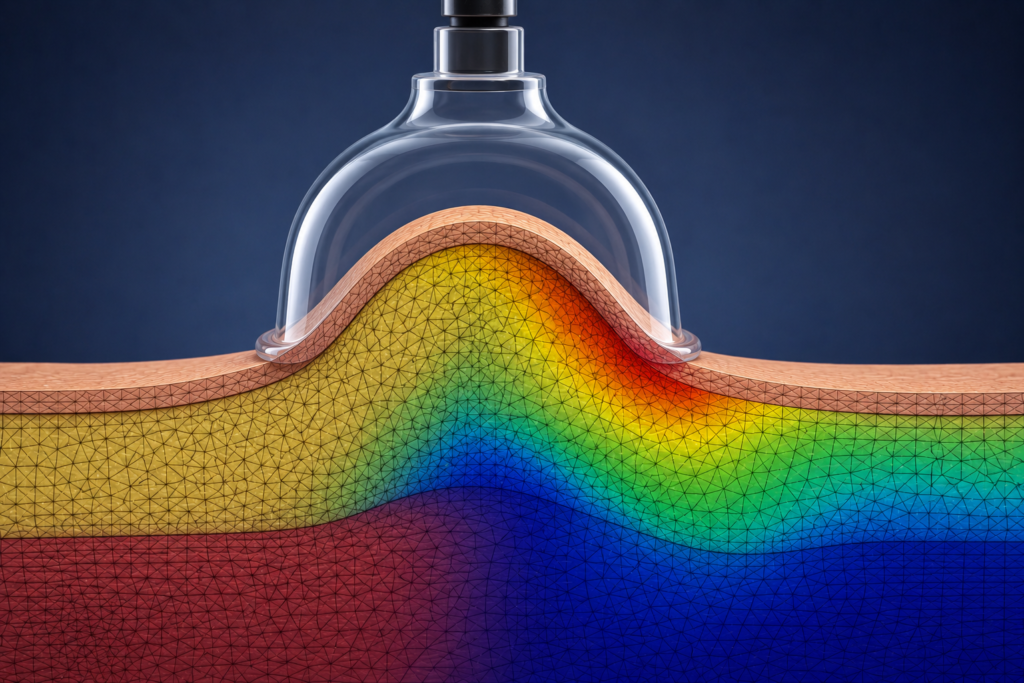
Researchers at the University of Massachusetts Lowell used COMSOL Multiphysics to study how human tissues respond to suction-based medical and cosmetic therapies such as cupping and cryolipolysis. The team developed a finite element model of human skin, fat, and muscle layers to simulate how tissues deform under localized suction pressure. Different material models were assigned to each tissue layer to capture their nonlinear mechanical behavior more realistically. Using the software’s Optimization Module, researchers also estimated patient-specific tissue properties by comparing simulation results with experimental deformation data.
The study found that suction cup diameter influences how deeply stresses penetrate into tissue, while thicker fat layers help absorb mechanical loads and reduce stress transfer to muscles. The research aims to support safer and more reliable design of suction-assisted medical devices through simulation-driven analysis.
Click to read the original article..
Image generated by: ChatGPT