


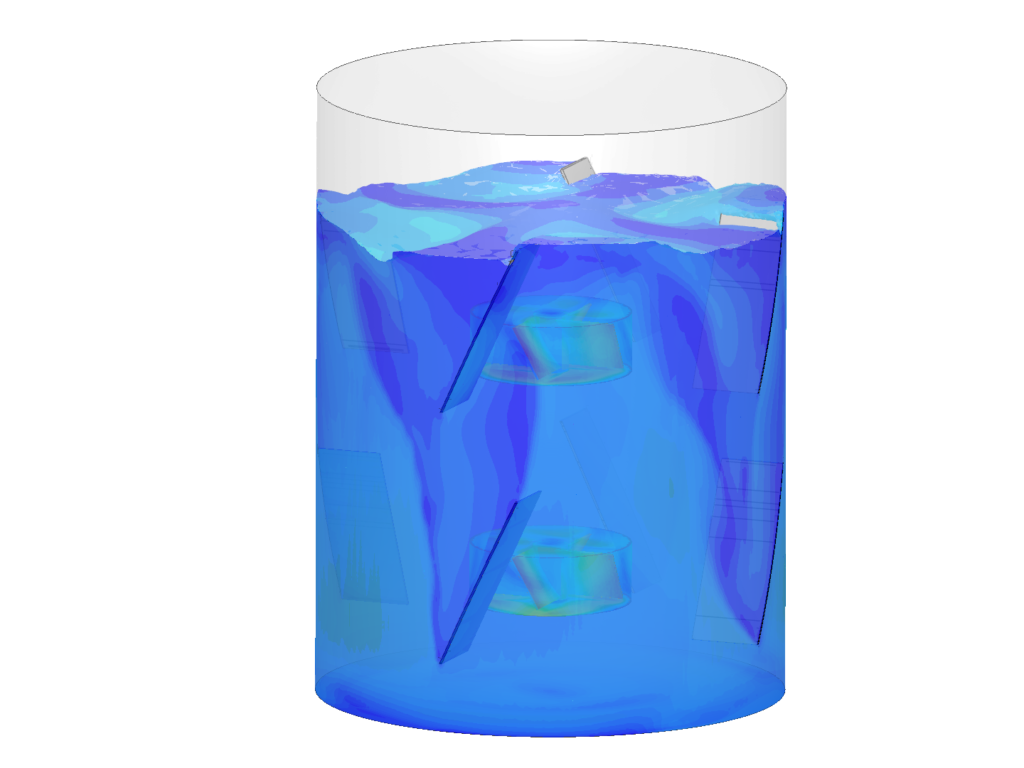
SimScale has published a guide outlining how Computational Fluid Dynamics (CFD) can be used to study liquid mixing in stirred tanks. It aims to show how much power an impeller draws, where liquid moves slowly or not at all, and how long a feed takes to blend.
The setup follows a step-by-step approach: calculating the impeller Reynolds number, preparing the liquid volume, placing the impeller inside a rotating zone using the Multiple Reference Frame (MRF) method, applying boundary conditions, and meshing the impeller region. Simulated power is then compared with published values before the flow pattern is interpreted. Blend time is measured through a separate transient run using a tracer.
For free-surface effects, air entrainment, or two immiscible liquids such as oil and water, multiphase simulation with the Volume of Fluid (VOF) method is used. The approach also extends to jet-mixed and flow-through tanks. SimScale’s Engineering AI agent can set up a multiphase mixing simulation from CAD, with the user reviewing the setup.
Overall, mixing tank simulation is presented as a structured process in which each setup choice is checked before the results are used to compare design variants.
Click to read the original article..
Image courtesy: SimScale