

Wind load analysis is the process of studying how wind affects a building and the forces it creates on its structure and outer surfaces. It helps architects and structural engineers assess safety and set design requirements.
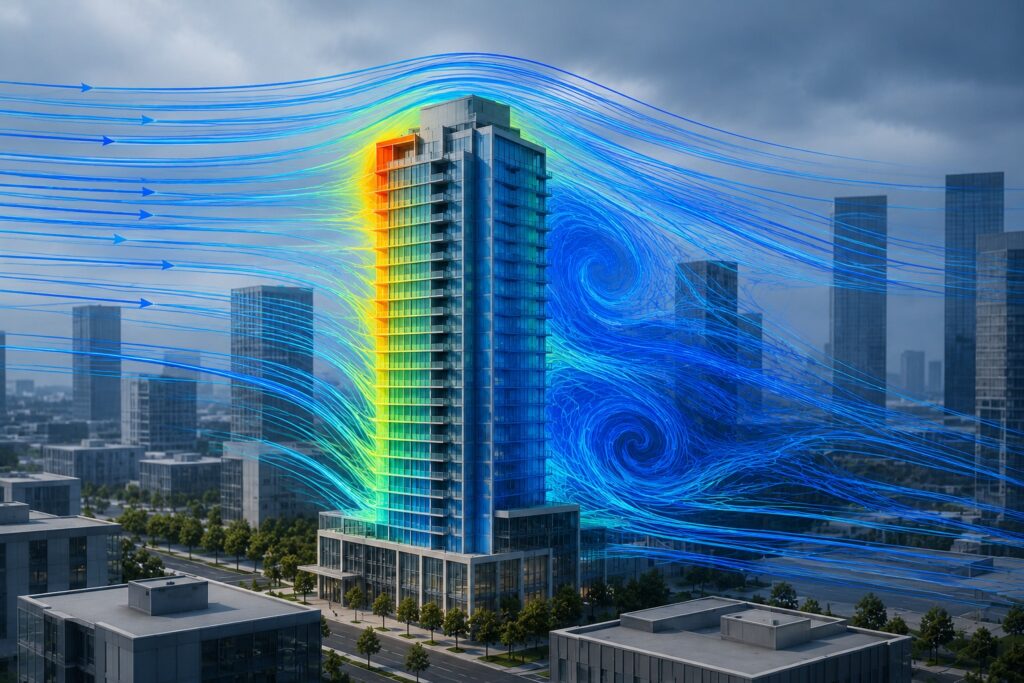
Wind pressure varies with speed, height, shape, surroundings, and terrain. Wind pushes on the windward face, while suction can act on the sides, rear, and roof. Corners, roof edges, and balconies can see strong local pressure or suction, depending on shape and wind direction. Tall, slender buildings can sway from vortex shedding, where swirling wind peels off the sides rhythmically. If that rhythm nears the building’s natural frequency, movement can amplify, affecting comfort.
Engineers calculate wind loads using codes such as ASCE and Eurocode. They consider the building’s risk category, site wind speed, terrain, and height, convert this into pressure, then apply coefficients. Internal pressure is checked too. The results guide the main frame, while windows, panels, and fasteners are assessed separately because they face higher local peaks. Codes vary by edition and country, so engineers confirm which version applies.
Code tables are based on a limited set of building shapes. Tapered towers, slender designs, or buildings with close neighbours may need wind tunnel testing, where a model is tested in controlled airflow.
SimScale’s blog explains that Computational Fluid Dynamics (CFD), a computer-based virtual wind tunnel, cannot be used alone for code approval but aims to help compare options early. Its examples show:
- Rounded corners weakened vortex shedding on a tall tower.
- Stepping back a supertall’s upper levels cut wind force far more than tapering.
- Closely packed tanks faced higher force than one alone.
Wind is invisible, yet it shapes how buildings are designed. By studying aerodynamics early, while corners, massing, and form can still change, engineers and architects can create structures that stand firm, feel comfortable, and respond calmly to every gust.
Image generated by: ChatGPT