


Designing robotic hardware involves testing how components respond to loads, heat, vibration, and impacts. The SimScale blog examines how four robotics and hardware teams used cloud-based FEA, CFD, and thermal simulation to validate designs before committing to physical hardware.
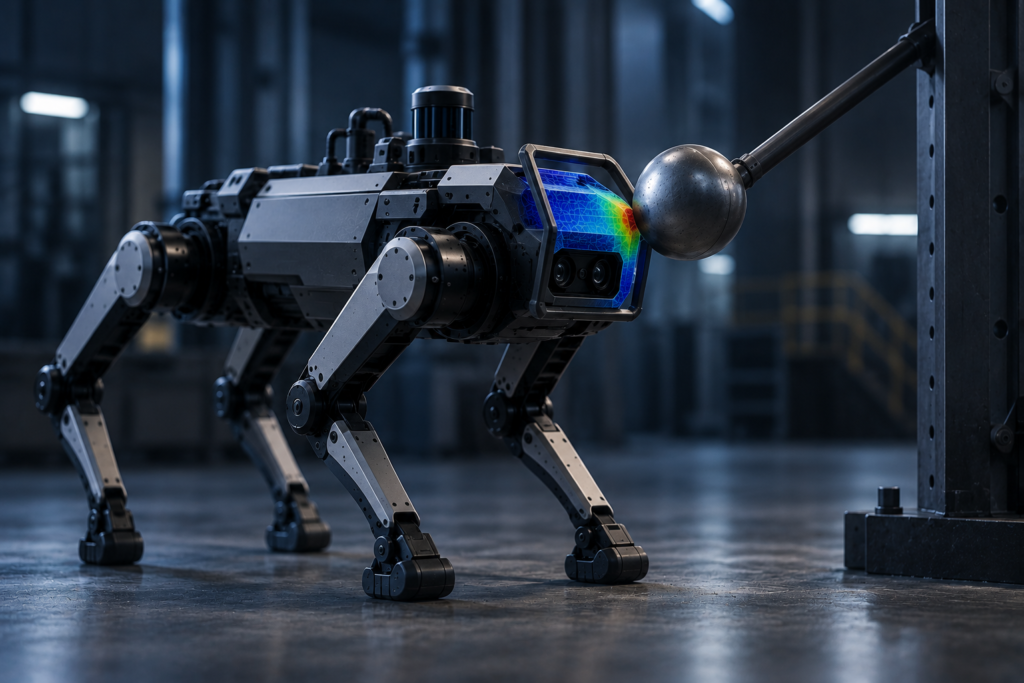
- ANYbotics used FEA to recreate a steel-ball impact test on its legged inspection robot, finding that a chamfered design spread the impact force over a larger area, keeping it below the damage threshold without adding material.
- Ati Motors ran static structural FEA to study chassis torsional stiffness across multiple load cases and design variants for its autonomous cargo vehicle.
- Carbomech used modal analysis to identify the natural frequencies of a high-speed spindle, then ran centrifugal-load analysis to define a safe operating speed range clear of resonance.
- Easee applied the Immersed Boundary Method for conjugate heat-transfer CFD to simulate its EV charger’s complex geometry without simplification, and used nonlinear structural FEA to design snap-fit enclosure features and diagnose an unexpected part failure.
Together, these cases show how simulation supports early-stage validation across different robotic hardware challenges.
Image generated by: ChatGPT