


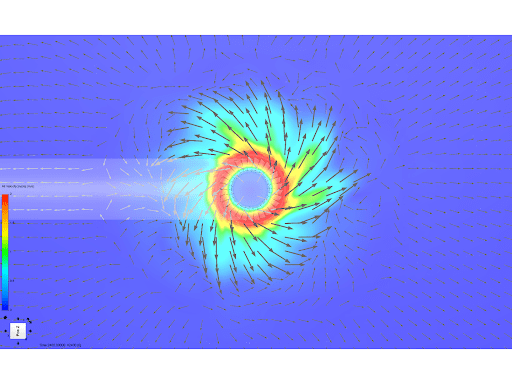
CFD (Computational Fluid Dynamics) ventilation simulation is widely used in HVAC design and building engineering to evaluate airflow behaviour digitally during the design stage. A SimScale blog examines how simulation can be applied at two levels:
- Component level: assessing Air Handling Units (AHUs), ductwork, diffusers, louvres, and fans for airflow behaviour, friction losses, turbulence, and pressure drop.
- Spatial level: analysing indoor air quality, CO₂ concentration, temperature distribution, and thermal comfort against standards such as ASHRAE 55, ISO 7730, CIBSE, and LEED.
The article also discusses Conjugate Heat Transfer (CHT) analysis for coupled airflow and heat-transfer studies across natural, mechanical, and mixed-mode ventilation scenarios, supporting early identification of design inefficiencies. Together, these capabilities aim to help engineering teams move from guesswork to evidence-based ventilation design.
Image courtesy: Simscale