



Your weekly sync on the pulse of the simulation industry
Industry News

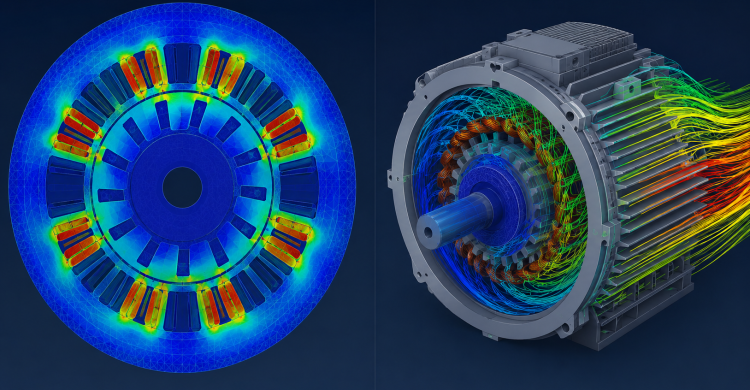
As the shift away from fossil fuels accelerates, the electric propulsion industry faces growing pressure to deliver powertrains that are both high-performing and cost-effective, a challenge demanding deep engineering expertise and rapid innovation.
Within this landscape, EMPEL Systems is developing electric motors and inverters that integrate directly into a single unit, an approach intended to reduce weight, volume, and thermal losses. As a startup without the R&D budgets of larger manufacturers, EMPEL needed to validate this complex, multi-physics design without relying heavily on costly, time-consuming physical prototyping. To do this, EMPEL worked with PDSVISION to implement several Ansys simulation tools:
- Ansys Motor-CAD, used for early evaluation of motor efficiency, power density, and thermal performance
- Maxwell, used for electromagnetic field analysis and optimization of stator and rotor geometries
- Fluent, used for thermal and fluid dynamics simulation to manage heat within integrated motor-inverter designs
- Mechanical, to access structural stresses and durability across components
This simulation-driven approach aims to help EMPEL bring its integrated motor-inverter platform to market with confidence, offering automotive, aerospace, and industrial customers a lighter, more efficient alternative to conventional powertrains.
Partnerships & Collaborations


Keysight and WIN Semiconductors have introduced a joint GaN MMIC design workflow that aims to reduce fabrication risk for 5G, satellite, and defense applications. It links on-chip simulation, layout verification, and evaluation board design, helping designers validate performance and support first-pass tapeout success.
Click to read more..
PhysicsX has partnered with Britain’s America’s Cup team, GB1, to apply physics AI in aerodynamics engineering. The collaboration aims to replace numerical simulation with AI inference, to help engineers train Large Physics Models, evaluate design variations efficiently, and support informed decision-making, reflecting a broader shift toward AI-native workflows across complex engineering industries.
Click to read more..
ENGYS and RBF Morph have announced a partnership to integrate the rbfCAE mesh morphing and shape optimisation platform with ENGYS’s HELYX and ELEMENTS simulation software. The collaboration aims to help engineers modify geometries directly on existing meshes, supporting design optimisation and fluid-structure interaction (FSI) workflows across sectors such as automotive, aerospace, marine, energy, and biomedical engineering.
Click to read more..


Scaleway, the European cloud and AI provider backed by the iliad Group, has acquired Qarnot, a European high-performance computing specialist. The deal aims to strengthen Scaleway’s platform with dedicated HPC and heat-reuse technology, reflecting a shared commitment to sovereign and sustainable computing for engineering, simulation and research workloads across Europe.
Click to read more..


Simulations Plus is integrating agentic AI into its Composer platform through NVIDIA‘s BioNeMo Agent Toolkit. The initiative aims to help AI agents ground insights in scientific literature while supporting GPU-accelerated simulation and quantitative systems pharmacology workflows for evidence-based, traceable drug development.
Click to read more..

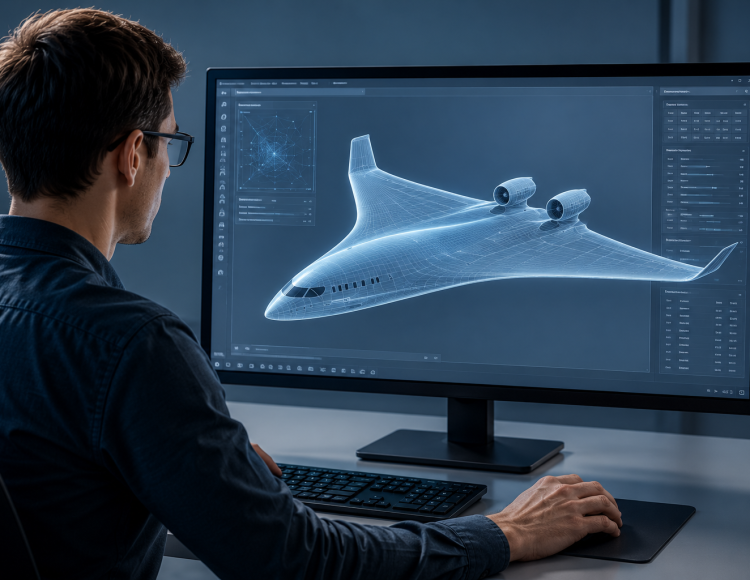
JetZero is developing a blended wing body aircraft, a shape that merges the wings and fuselage into one structure. It is using nTop’s design software along with NVIDIA’s NemoClaw AI agents, which aim to automatically update the aircraft’s geometry and run engineering analysis whenever design changes are made.
Click to read more..
Rescale has proposed a collaboration with Lawrence Berkeley National Laboratory, Oak Ridge National Laboratory, and Lawrence Livermore National Laboratory through the Agentic HPC Pipeline Initiative. The initiative aims to use agentic AI on Rescale‘s platform to make DOE-developed simulation codes more accessible to American manufacturers.
Click to read more..
Industry Events
This Foundational Fridays webinar introduces nonlinear simulations in Ansys Mechanical, covering how to define nonlinear materials in Engineering Data, set up contact interactions between components, and configure key nonlinear solver settings. Attendees will also learn to monitor solution progress and postprocess results for large-deformation structural problems.
📅 July 17, 2026
🕚 11:00 – 12:00 EST
Electrodeposition is widely used in semiconductor processing, electronics manufacturing, metal refining, and surface coatings. This webinar demonstrates how COMSOL Multiphysics® predicts current distribution, deposition rate, and coating uniformity across complex geometries. It also explores how coupling flow, temperature, and deformed geometry effects help guide cell design and optimize electrodeposition processes.
📅 July 21, 2026
🕚 11:00 – 12:00 EDT
This webinar spotlights the CONVERGE Academic and Explore Programs, which provide free licenses, training resources, and technical support to students, researchers, and educators. Hear how students built CFD careers using CONVERGE, and learn from professors advancing hydrogen combustion, renewable energy, and aerodynamics research.
📅 July 22, 2026
🕘 9:00 – 10:00 CDT
Modern radar and wireless systems rely on programmable, wideband beamforming platforms, making design-by-prototype increasingly impractical. This webinar explains RF digital twins, demonstrating how models, simulations, and measurements are integrated into a digital thread that supports early feasibility studies, hardware/software co-development, system verification, and mission-level performance evaluation before hardware is finalized, reducing development risk and design iterations.
📅 July 23, 2026
🕡 18:30 – 19:30 IST
In FOCUS
Company in Focus

Who they are
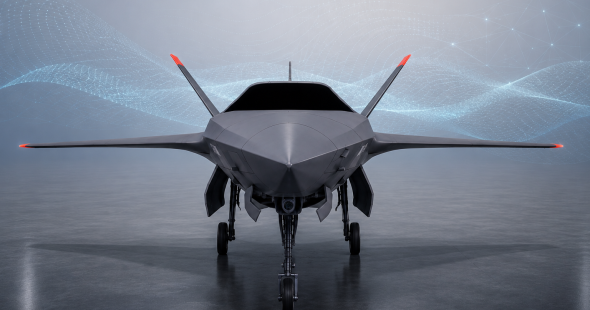
Paninian Aerospace is a Hyderabad-based deep-tech startup founded in 2018 by Raghu Adla, with a manufacturing facility at Adibatla Aerospace Park and a design centre in Whitefield, Bengaluru. Under its Svayatt brand (Sanskrit for “autonomous”) the company builds indigenous unmanned combat aerial platforms and in-house jet propulsion systems, aiming to reduce India’s reliance on imported defense technology.
Solutions & Technology
Paninian’s stack spans three layers:
- Aerial Platforms: Svayatt M1, a Collaborative Combat Aerial Vehicle built to fly alongside manned aircraft; Svayatt L1, a low-observable deep-strike platform with terrain-hugging flight; and Svayatt TD-1, a target and decoy drone system.
- Power Plants: The Yantur engine family covers aero, marine, and ramjet propulsion, including an in-house turbofan and a newly unveiled ramjet engine aimed at supersonic and hypersonic platforms.
- Digital Platforms: Kalman Intel, an AI-driven mission intelligence system for sensor fusion, GPS-denied navigation, and swarm coordination, alongside a Digital Twin platform (EntropyHub, AirVoxels) combining simulation, AI, 3D, and Model Based Systems Engineering.
- Manufacturing: A Lean Lab-based Avionics facility supports custom payload integration in a clean-room environment, built to global compliance standards.
Applications:
- ISR, air-to-surface, and anti-ship missions in contested battlespaces
- Electronic warfare and strike operations
- Target and decoy systems for training and threat simulation
Did you know?
Paninian won the ELCINA Defennovation Award 2024 for its contributions to aerospace systems and was selected for both T-Hub’s LAB32 accelerator and the India-to-America (I2A) Launchpad—recognizing the company’s innovation and its potential to scale advanced aerospace technologies globally.”
Solutions Focus:
Paninian’s core bet is vertical integration — airframe, propulsion, and mission-AI engineered in-house at its Lean Lab and validated through digital twins before physical builds, aiming to compress development cycles for next-generation autonomous defense platforms under India’s Make in India initiative.
Click to know more..
Technology Focus


When someone goes missing in dense forest or rugged terrain, conventional rescue methods often fall short. Search dogs depend on weather conditions, infrared cameras cannot see through tree cover, and helicopter crews may struggle to spot a person whose clothing blends into the landscape. To close this gap, Spain-based CENTUM developed Lifeseeker, a cellular detection system that aims to convert an ordinary mobile phone into a locator beacon for search-and-rescue teams.
Mounted on a helicopter alongside cellular and GPS antennas, Lifeseeker effectively becomes a temporary mobile cell tower. It connects only to the specific phone being searched for, filtering out unrelated devices nearby, and uses time-of-flight analysis and signal processing to estimate a missing person’s location, even in areas with limited or no conventional cellular coverage.
Making this possible is an extensive simulation process built on MathWorks’ MATLAB and Simulink platforms.
- Communications, LTE, and 5G Toolboxes generate, modify, and decode signals across cellular generations
- Signal Processing and Radar Toolboxes help optimize processing methods
- RF, Antenna, and Phased Array System Toolboxes emulate hardware effects on the signal processing chain
- Mapping and Navigation Toolboxes support geolocation algorithm development.
- CENTUM also anticipates adapting its systems for AI-based processing using Deep Learning Toolbox as it prepares for 6G
Before deployment, algorithms are validated in the lab using software-defined radios — grounding a complex engineering effort in a simple, human goal: helping someone find their way home.