

Site icon

Simpulse Insight #16

.single-post-wrp .single-p-hdr { height: 30vh!important; }

Your weekly sync on the pulse of the simulation industry

Industry News

Gemini_Generated_Image_5ztu7f5ztu7f5ztu
Image: Gemini

Diesel-powered tractors remain the backbone of Indian farming, but concerns around emissions and sustainability are driving interest in alternative technologies. Bengaluru-based Moonrider is developing electric tractors and high-voltage battery packs in-house as part of this shift. Since battery components suited for diesel-equivalent tractor applications are not widely available in India’s low-voltage EV ecosystem, the company has built its battery architecture from the ground up. To support product development, Moonrider uses Dassault Systèmes’ 3DEXPERIENCE platform on the cloud for fluid, thermal and structural simulations, enabling virtual testing before physical prototypes are built. The company has also adopted ENOVIA for product lifecycle management and is exploring opportunities in Southeast Asian and European markets, while evaluating future applications of autonomous vehicle technologies in agriculture.

Click to read the original article..

Partnerships & Collaborations

Image: Gemini

Quantinuum and Synopsys have announced a strategic collaboration to integrate quantum computing into industrial engineering simulation workflows. The initiative focuses on CFD and electromagnetic simulation, exploring methods to address computational challenges in aerospace and advanced electronics design.
Click to read more..

Siemens and KION have entered a strategic partnership focused on digitalizing intralogistics operations. The companies will combine AI, automation, industrial data and digital twin technologies, including Siemens’ Digital Twin Composer, to enable simulation-driven warehouse planning and support more resilient supply chains.
Click to read more..

Keysight Technologies, NTT DOCOMO, and NTT are collaborating under an existing MoU to advance realistic 6G channel modeling and distributed MIMO simulation. The initiative aims to support more realistic, repeatable, and scalable evaluation of next-generation wireless architectures before real-world deployment.
Click to read more..

BMW Group and Mistral AI have partnered to advance the use of AI in crash simulation. The partnership aims to combine BMW’s industrial engineering datasets with Mistral AI’s model development capabilities to create domain-specific Large Industry Models for vehicle safety development.
Click to read more..

Image: ChatGPT

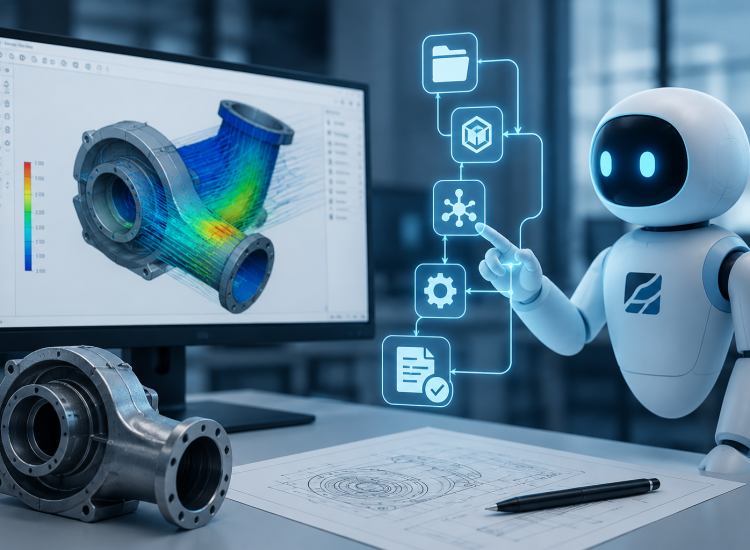
SimScale has opened a guided pilot waitlist for its Engineering AI agents, giving enterprise teams access to AI-driven simulation orchestration. The agents aim to interpret engineering requirements, automate simulation workflows, and incorporate company-specific standards and compliance requirements.
Click to read more..

Image: Gemini

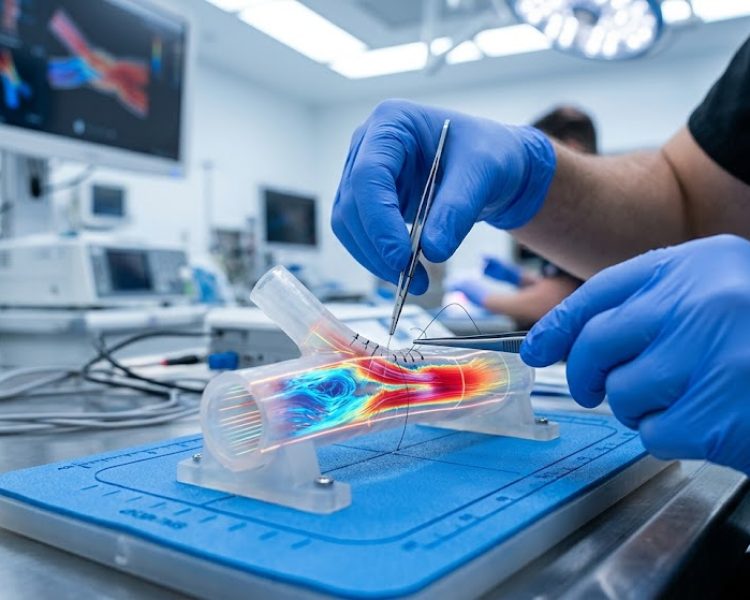
YourAnastomosis uses Ansys Fluent and CFX to analyse blood flow dynamics and finite element models to assess suture lines, aiming to provide surgical trainees with personalised, data-driven feedback that links technique to patient-specific vascular outcomes, addressing a long-standing gap in traditional surgical training.
Click to read more..

Image courtesy: Siemens

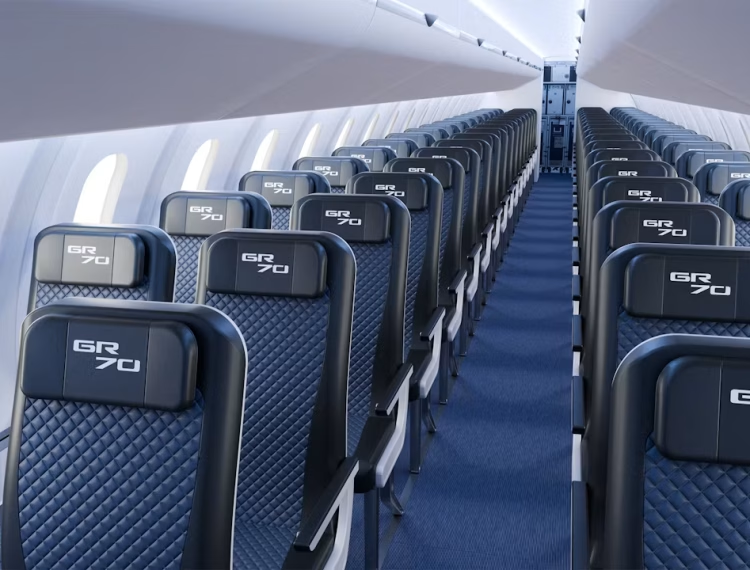
To address the growing regional aircraft shortage, the Montreal-based startup used Siemens’ NX for 3D modelling, Simcenter STAR-CCM+ for computational fluid dynamics and Simcenter 3D for structural and thermal analysis, integrating all workflows into a single digital thread to design its hybrid-electric regional jet.
Click to read more..

Image: ChatGPT

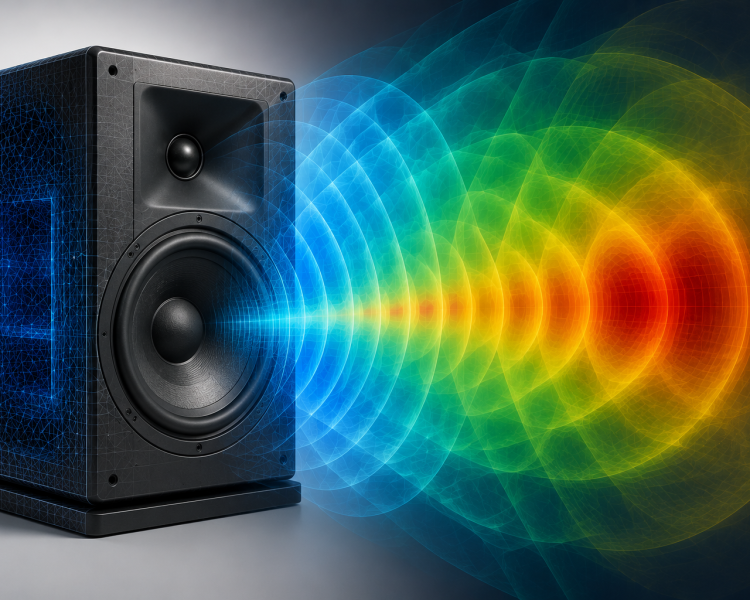
GSS Audio is using Quanscient Allsolve to support loudspeaker transducer development through multiphysics simulations that combine electrical current flow and magnetic effects. The company aims to unify design, simulation, optimization, and prototyping activities within a single workflow.
Click to read more..

Industry Events

As hydrogen gains momentum as a low-carbon fuel, understanding its combustion characteristics is critical for next-generation engine and turbine development. This webinar examines CFD-based approaches for modeling H2 combustion, covering flame behavior, emissions, ignition dynamics, and challenges in developing efficient hydrogen-powered systems.

🗓️ June 22, 2026

🕘 09:00 – 12:00 CEST

High-fidelity simulation turnaround times and fragmented engineering data are key bottlenecks limiting design exploration in automotive CAE. This webinar examines how embedding AI natively within existing CAE workflows can accelerate design iterations, improve optimization coverage, and capture institutional knowledge without disrupting established simulation processes.

🗓️ June 24, 2026

🕗 08:00 – 09:00 PT

Valves are often a major source of inefficiencies, vibration, cavitation, and maintenance challenges in industrial systems. This webinar explores how multiphysics simulation spanning CFD, structural FEA, and electromagnetics supports valve analysis, design optimization and in-service troubleshooting from early design stages through operational lifecycle.

🗓️ June 24, 2026

🕒 15:00 – 16:00 BST

Collecting annotated radar data across diverse operating conditions and edge cases remains a significant challenge in radar system development. This webinar examines synthetic data generation across multiple abstraction levels from probabilistic models to physics-based simulations to support algorithm development, validation, hardware-in-the-loop testing, and the evaluation of advanced sensing architectures.

🗓️ June 25, 2026

🕒 15:00 – 16:00 IST

In FOCUS

Company in Focus

Image : ChatGPT

Who they are

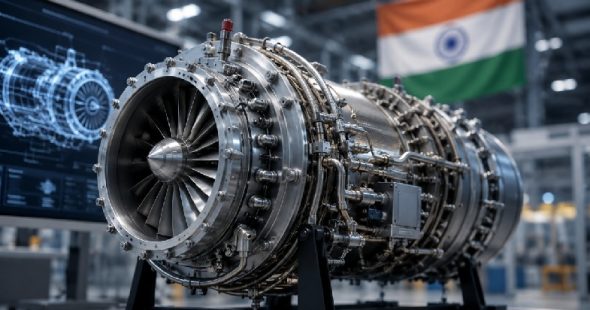
Nabhdrishti Aerospace is an Indian deep-tech startup building indigenous micro gas turbines for propulsion and power generation. Headquartered at the IHUB building within the Indian Institute of Science (IISc), Bangalore, the company is focused on bringing world-class, locally designed and developed engineering technology to the market at competitive prices.

Solutions & Technology

The company’s technology focuses on building micro gas turbines that offer superior performance while radically undercutting standard market costs through a specialized, localized approach:

  • One Core Engine, Dual Use: Their fundamental design philosophy relies on a single core architecture that seamlessly adapts to multiple, distinct applications.
  • High Efficiency: By incorporating an innovative, custom-designed recuperator, their engines achieve a greater than 15% efficiency increase compared to existing turbines in their class.
  • Fuel Flexibility: The turbine platform is uniquely designed to run on conventional fuels, biofuels, and hydrogen.
  • Superior Performance: The technology is engineered for high-altitude performance, remaining highly efficient even in demanding environments.
  • Lower Cost: By leveraging local engineering talent and a domestic supply chain, their products cost less than 50% of any other turbine in its class.

Applications:

Thanks to their dual-use single core architecture, Nabhdrishti’s solutions cover two major industrial landscapes:

  • Aviation: Used for Unmanned Aerial Vehicles (UAVs), Hybrid Electric Flight platforms, and small planes or helicopters.
  • Distributed Power Generation: Deployed across commercial real estate (hospitals, malls, apartments), manufacturing facilities, the Oil & Gas sector, and serving as range extenders for heavy vehicles.

Did you know?
Nabhdrishti Aerospace is building India’s first fuel flex micro gas turbine for use in aviation and power generation.”

Solutions Focus:

The company’s immediate product focus centers on their first engine platform:

  • ND 400 Engine: A specialized 400 N (Newton) micro gas turbine. The company is actively focusing on the “ND 400 Engine Journey,” positioning it as a highly efficient, lower-cost alternative for both aerospace propulsion and localized power generation.

Click to know more..

Technology Focus

Image: ChatGPT

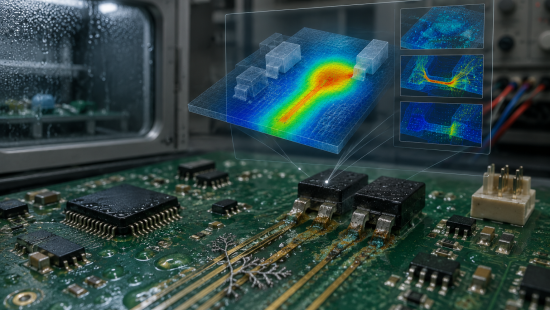
The Centre for Electronic Corrosion (CELCORR), a research group at the Technical University of Denmark (DTU), aims to address a significant challenge in electronics — corrosion-induced failures caused by humidity and moisture exposure.

With the growing adoption of high-voltage electronics across sectors such as electric vehicles, wind farms, data centers, and server farms, the risk of humidity-related failures has become a growing concern. Condensation on electronic surfaces can trigger electrochemical processes, leading to leak currents and dendrite shorting, which can result in serious operational failures and reliability issues. According to the researchers, a large share of electronics failures are classified as having no identifiable root cause, often because moisture evaporates without leaving visible signs of corrosion.

To address this, CELCORR’s research approach involves:

  • Building multiphysics simulation models using COMSOL Multiphysics® software to study how design elements like electrode spacing, water film thickness, and electrolyte conductivity influence leak current behaviour on printed circuit boards (PCBs).
  • Developing accessible simulation apps through the Application Builder, allowing industry partners to independently test design variables in a plug-and-play environment without requiring deep simulation expertise.
  • Expanding research scope with the establishment of the Centre for Climate Robust Electronics Design (CRED), supported by a grant from the Grundfos Foundation, to address humidity-robustness needs of high-power electronic systems.

The research aims to bridge the gap between materials science and electronics engineering, providing industries with the understanding needed to build components that can withstand challenging environmental conditions.

Click to read the original article..

Exit mobile version