


Your weekly sync on the pulse of the simulation industry
Industry News

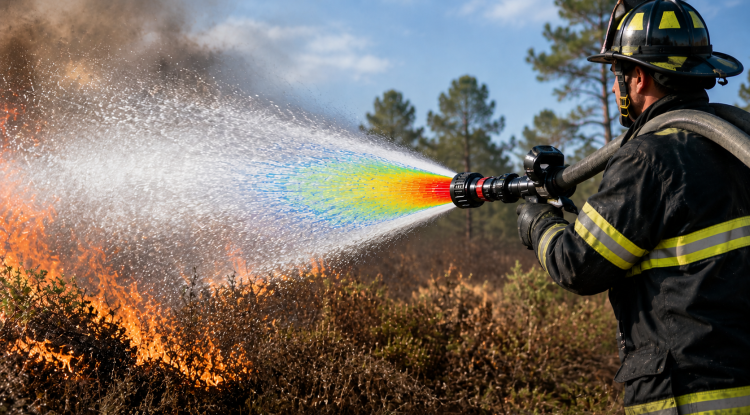
Every second counts when a fire breaks out, and yet the equipment firefighters rely on has seen little innovation in decades. As wildfires grow more intense and water scarcity becomes a pressing reality, the demand for more resource-efficient firefighting tools continues to grow.
HEN Technologies, a California-based company, aims to address this by developing advanced fire suppression nozzles that seek to optimize water flow, velocity, droplet size, and coverage across both structural and wildland firefighting environments.
A firefighting system involves multiple hoses, shut-off valves, pressure devices, and pumps all working together. When some firefighters close their hoses mid-operation, dangerous backward pressure surges through the entire system. Wind interference can further affect water distribution and coverage. Such complex, interconnected forces are where multiphysics simulation proves essential.
This is where Ansys plays a key role. Ansys CFX and Ansys Fluent simulate internal nozzle flow pathways, analyse fluid velocity, pressure distribution, and droplet behaviour under real-world conditions, helping engineers better understand how water moves through the system. Ansys Mechanical evaluates the structural integrity of nozzle components under intense pressure loads, identifying stress points and deformation risks early, ensuring the equipment is structurally sound for the unpredictable demands of active firefighting.
Partnerships & Collaborations


Siemens EDA and TSMC have expanded their collaboration to integrate AI-powered automation into semiconductor design workflows. Siemens’ EDA tools are now certified for TSMC‘s advanced N2, A16, and A14 process technologies, helping chip designers improve productivity, manage growing design complexity, and accelerate development at leading-edge nodes.
Keysight Technologies and SRC UK have entered a strategic collaboration to support defense organizations in modernizing their electronic warfare (EW) test and simulation environments. The initiative focuses on transitioning customers to open, software-defined architectures while preserving existing threat libraries and test assets.
Cadence and NVIDIA have expanded their collaboration, bringing together agentic AI, physics-based simulation, and digital twin technologies to reshape engineering workflows across semiconductor design, physical AI systems, and hyperscale AI infrastructure.

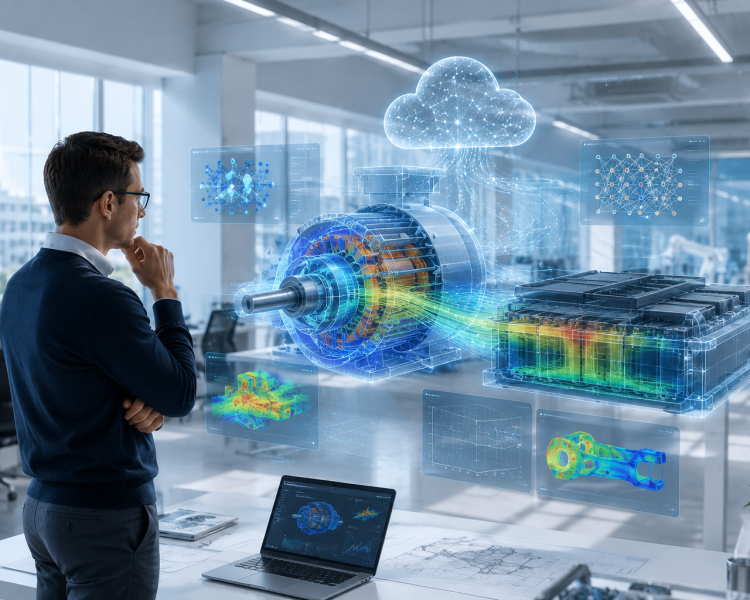
Quanscient has raised €10 million in a Series A round led by 55 North and B&C Group. The company aims to combine cloud-scalable multiphysics simulation, quantum computing, and AI to address hardware engineering challenges across the energy, aerospace, and automotive sectors.
Click to read more..

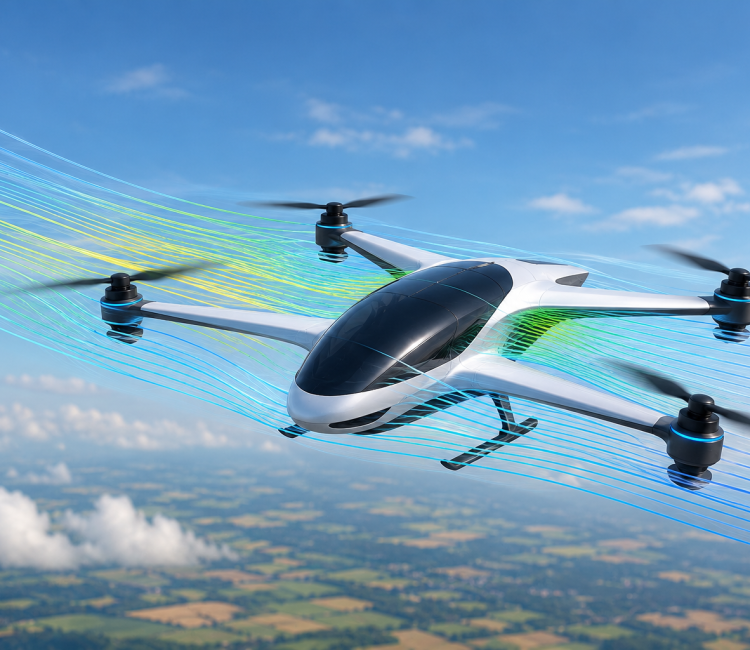
Drone and aerospace teams including VTOL Technologies, TECNALIA, Turbulence Solutions, and Outbound Aerospace used SimScale’s cloud-based CFD and FEA tools to study fuselage-wing integration, impeller designs, turbulence-cancelling flaplets, and blended-wing-body aerodynamics, reporting variations in drag, lift, and turbulence load behaviour across flight conditions.
Click to read more..
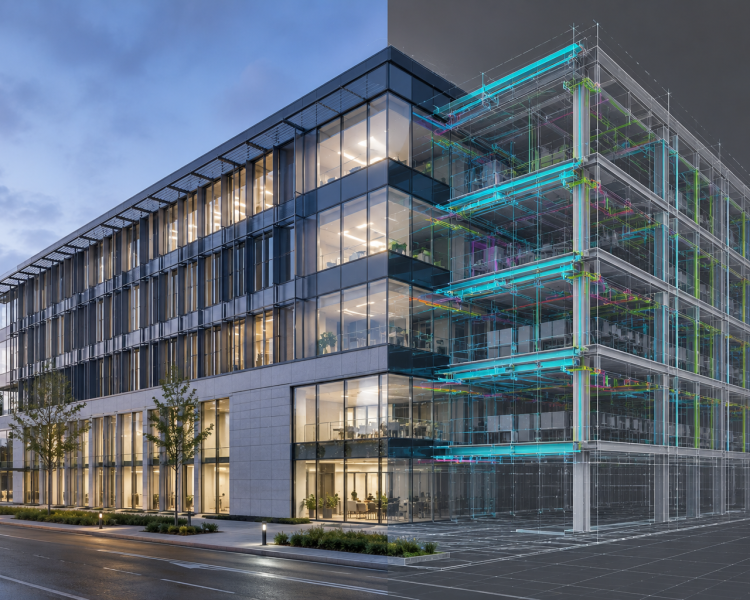
Façade engineering company, Stekar aims to eliminate design silos and improve engineering quality by adopting Dassault Systèmes’ 3DEXPERIENCE platform with CATIA and ENOVIA. Its shift to 3D parametric design targets near-zero drawing defects, smoother collaboration, and future DELMIA integration for digital manufacturing planning.
Click to read more..
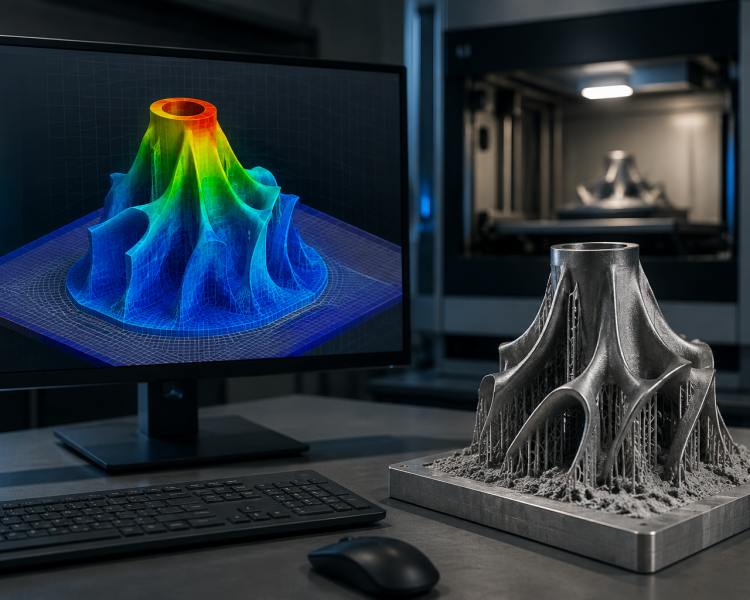
PanOptimization’s PanX aims to address simulation challenges in metal additive manufacturing, where conventional FEA tools face limits with large, complex geometries. Using Periodic Adaptivity and Multi-Grid Modelling, it aims to handle larger models, including loose powder and build plate, for thermal and distortion prediction.
Click to read more..
Industry Events
As AI and cloud workloads push stationary battery storage systems closer to their thermal limits, predicting overheating becomes increasingly critical. This session demonstrates how to use nonlinear system identification with MATLAB and System Identification Toolbox to forecast cell temperatures and develop safer control and cooling strategies.
🗓️ June 10, 2026
🕦 23:30 – 00:30 IST
This webinar provides a recap of key insights from the 2026 ASSESS Simulation Leadership Summit, highlighting emerging initiatives across AI/ML, digital twins, simulation credibility, integration, and democratization. Attendees will gain an update on ongoing projects, future priorities, and collaborative efforts shaping the future of engineering simulation.
🗓️ June 11, 2026
🕙 10:00 – 11:00 EDT
Many engineering teams assume GPU-accelerated CFD requires expensive, high-end hardware. This webinar examines how the Ansys Fluent GPU solver can be deployed on workstation-grade GPUs for engineering simulations. Attendees will explore:
- Real-world benchmarks and application examples
- GPU-based workflows for conjugate heat transfer, rotating machinery, and external aerodynamics
- Practical hardware selection considerations for different budgets and simulation requirements
🗓️ June 11, 2026
🕚 11:00 – 12:00 EDT
Advanced simulation is increasingly being extended beyond CAE specialists through simulation apps, surrogate models, and digital twins. This COMSOL Day event showcases how organizations are deploying custom applications to accelerate decision-making and collaboration. Attendees will learn:
- How to build and deploy simulation apps organization-wide
- The role of surrogate models in enabling fast digital twins
- Real-world applications in battery and power electronics development
🗓️ June 11, 2026
🕙 10:00 – 15:00 CEST
In FOCUS
Company in Focus

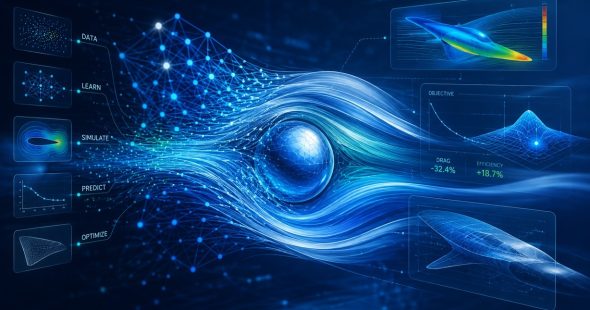
Who they are
Navier AI is a San Francisco-based industrial AI startup founded in late 2023 by aerospace engineers and former alumni from top-tier companies like SpaceX and Tesla. Backed by Y Combinator, the company’s mission is to give every hardware engineer the computational leverage of an entire team by building the world’s first autonomous engineering agents.
Solutions & Technology
The core innovation behind Navier AI is its shift from simple simulation tools to Agent-Driven Engineering.
- AI Copilots & Agents: Instead of requiring engineers to manually wrestle with software, Navier’s AI agents automatically understand 3D geometry, reason about physics, and manage computational workflows.
- End-to-End Automation: The platform web-integrates with industry-standard solvers like OpenFOAM. The AI handles tedious setup phases—including geometry cleanup, mesh generation, and solver configurations—and runs them natively in the cloud.
- Human-in-the-Loop Trust: To guarantee reliability, a Navier expert engineer reviews every agent-configured simulation for convergence and quality before full-scale compute begins.
Applications:
Navier AI focuses on accelerating the heavy physical prototyping phases across specialized, high-performance hardware fields:
- Aerospace: Streamlining aerodynamics testing, wing design sweeps, and rocketry simulations.
- Automotive: Optimizing vehicle drag coefficients and thermal fluid behavior.
- Advanced Manufacturing: Accelerating overall design-to-production cycles for complex mechanics and 3D-printed hardware parts.
Did you know?
Navier AI’s core platform is built to execute high-precision fluid simulations significantly faster than traditional engineering software by replacing weeks of manual legacy computing with instant, machine-learning-driven physics solvers.”
Solutions Focus:
The overarching goal of Navier AI is to eliminate simulation overhead. By changing the paradigm so engineers just “describe the problem” in plain text rather than configure the math, Navier shifts the human focus entirely from setting up tooling to making high-value design decisions. This shrinks engineering timelines from weeks to minutes.
Technology Focus

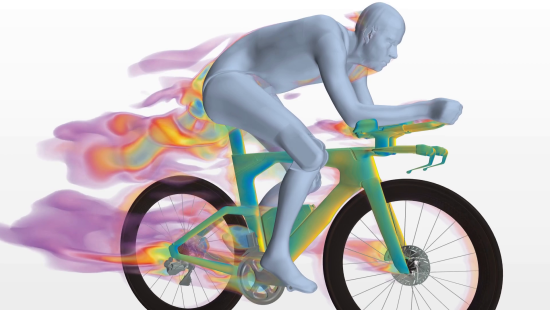
Bicycles may look simple, but the engineering behind a high-performance bike has evolved significantly over the decades. Siemens’ Simcenter, a simulation platform used across industries including automotive and aerospace, is increasingly finding its place in the cycling world, helping manufacturers move from trial-and-error prototyping to simulation-driven design.
Here is a look at where it is making an impact:
- Aerodynamics: Trek Bicycle used CFD simulation to study airflow around bike frames and riders, exploring design variations from rider positioning to water bottle placement to find the most efficient configuration.
- Helmet safety & thermal comfort: Helmet manufacturers are using Multiphysics simulation for both impact testing and airflow analysis, helping strike the right balance between ventilation and aerodynamic efficiency.
- E-bike noise & vibration: As e-bikes go mainstream, drivetrain noise has become a key quality metric. MAHLE is using Simcenter testing solutions to analyse and reduce noise-vibration-harshness (NVH) in e-bike drivetrains.
- Structural & wheel design: Radiate Engineering, in collaboration with Scott Sports, used simulation to develop a monocoque carbon wheelset, optimising for aerodynamics, crosswind stability, and structural performance simultaneously.
- System-level simulation: From hydraulic transmission concepts to fluid-structure interaction studies on something as focused as a tire valve, simulation is being applied across the full complexity spectrum of bicycle engineering.
Whether it is a carbon wheelset, a helmet vent, or a tire valve — the level of engineering detail going into modern bicycles tells a story about where product development is headed across all industries.
Click to read the original article..