
Your weekly sync on the pulse of the simulation industry
Industry News
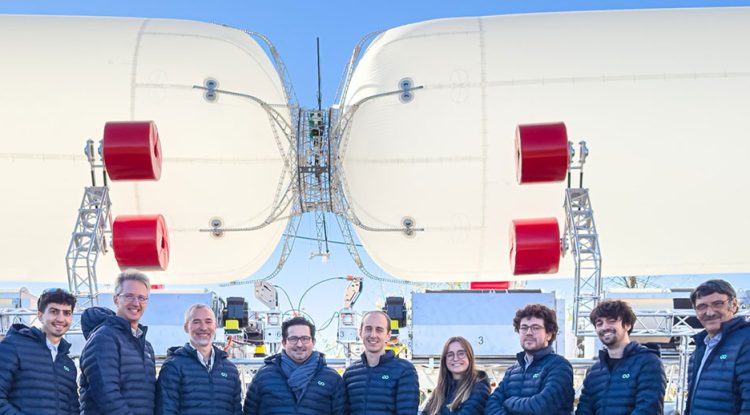
Wind Fisher, a France-based startup, is developing a high-altitude wind energy system called MAG (Magnus Air Generator), designed to harness stronger and more consistent winds at elevations of 300 to 500 meters. The MAG system uses a helium-filled rotating cylindrical balloon connected to a ground station through cables, generating electricity through the Magnus effect.
To support the technology’s development, the company is using simulation solutions from Ansys, including Ansys Discovery 3D for concept design, Ansys Fluent for aerodynamic and airflow simulations, and Ansys optiSLang for design optimization and performance analysis. As airborne wind energy gains attention globally, systems like MAG highlight how simulation-led engineering could influence the future of renewable power generation.
Partnerships & Collaborations
PhysicsX, an AI-native engineering company, has announced a strategic partnership with CoreWeave to deploy its platform on CoreWeave’s GPU cloud infrastructure. The collaboration aims to help enterprise customers train domain-specific Large Physics Models (LPMs) on proprietary data and deploy them securely at scale.
Flexcompute and Northrop Grumman, in collaboration with NVIDIA, have developed an AI Physics model that aims to automate the simulation of thruster plume impingement, a longstanding challenge in spacecraft docking. Built on NVIDIA’s PhysicsNeMo framework, the model is designed to provide real-time predictions with built-in uncertainty estimation to support mission-critical engineering decisions.
Synopsys has partnered with TSMC to power next-generation AI systems using silicon-proven IP, certifies AI-powered EDA flows, and system-level enablement. The collaboration spans TSMC‘s advanced process nodes, including 3nm, 2nm, A16, and A14 technologies, and aims to optimize design productivity, chip integration and multiphysics optimization requirements.
European AI company Mistral AI has acquired Austrian engineering startup Emmi AI. The acquisition integrates Emmi’s physics-based AI models and research team into Mistral AI, aiming to build a comprehensive industrial engineering AI stack for simulation workflows across multiple industries.
Click to read more..
BMW is using SIMULIA technologies to analyse the behaviour of electric drivetrain components, including rotors, gearboxes, housings and roller bearings, under real operating conditions. The company is combining Abaqus, Simpack and Tosca for structural, vibration and system-level simulations to study stiffness, friction, acoustic behaviour and housing deformation in EV drivetrains.
Click to read more..
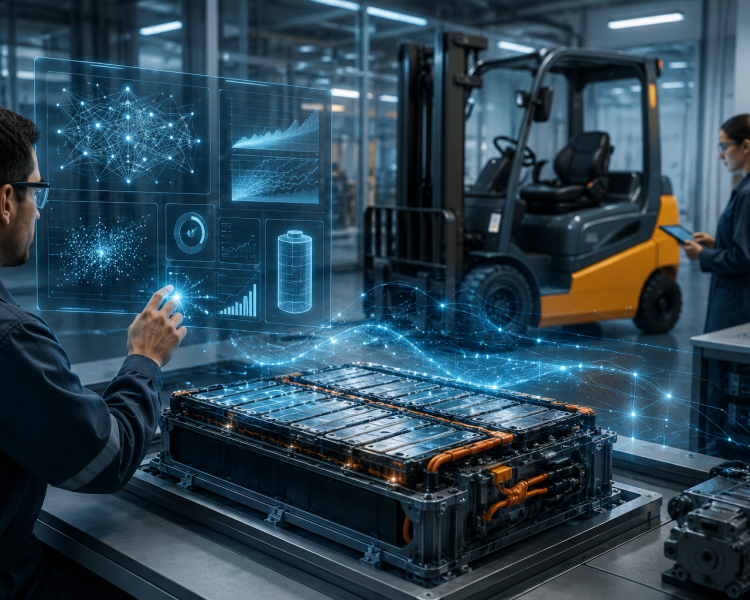
Jungheinrich is using Monolith’s predictive AI models to analyse battery testing data for its industrial vehicles. The models are intended to help engineering teams interpret complex test results, reduce dependence on physical testing, and support product validation and battery development processes.
Click to read more..
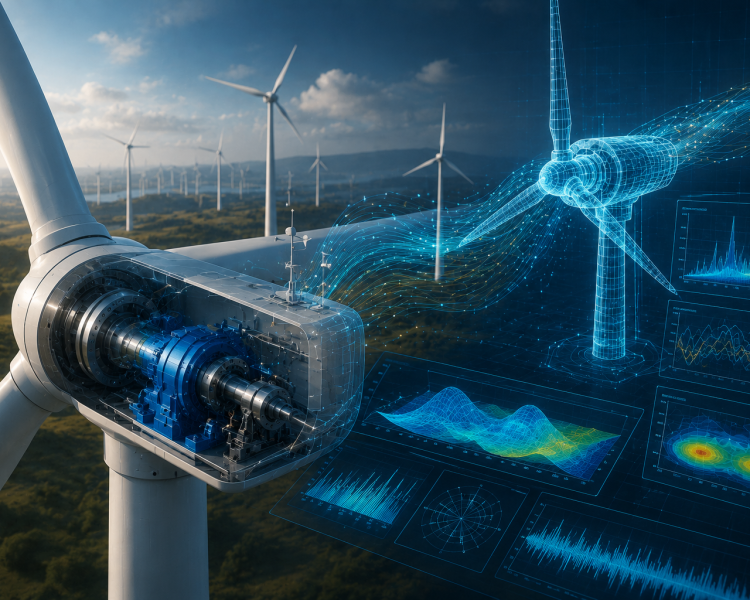
AVL‘s multibody dynamics software, EXCITE™ M, aims to support wind turbine drivetrain development through simulation of plain bearing lubrication, gear meshing, torsional vibrations, NVH, and reliability analysis. The platform addresses industry challenges related to gearbox failure rates and manufacturing costs using detailed drivetrain simulation models.
Click to read more..
Industry Events
With growing adoption of EVs, effective thermal management has become essential for lithium-ion battery safety and performance. This webinar explores simulation-driven methods for analyzing battery cell, module, and pack behavior, covering temperature distribution, electrothermal coupling, thermal runaway prediction, MSMD modeling, and reduced-order techniques for pack-level thermal simulations in Ansys Fluent.
🗓️ May 26, 2026
🕚 11:00 – 12:00 IST
This webinar explores reduced order modeling (ROM) workflows for motor drive, inverter, and battery systems using MATLAB and Simulink. It aims to demonstrate how detailed electromagnetic and thermal models can be converted into computationally efficient representations to support system-level simulation, control development, hardware-in-the-loop testing, and digital twin applications.
🗓️ May 27, 2026
🕦 23:30 – 00:30 IST
The session explores how SIMULIA technologies support the simulation of antenna interactions with the human body across smartphones, wearables and immersive technology. It aims to discuss electromagnetic field modelling, RF exposure assessment, antenna performance evaluation, regulatory compliance considerations, and the role of virtual simulation in human body interaction studies.
🗓️ May 28, 2026
🕥 22:30 – 23:30 IST
The webinar examines a stand-alone workflow for high-fidelity end-to-end image simulation using Keysight’s Lens Performance Data (LPD) approach. It aims to cover image formation analysis, lens performance characterization, aberration and resolution modeling, secure sharing of optical performance data, and collaborative simulation workflows without exposing proprietary lens design details.
🗓️ May 28, 2026
🕙 10:00 – 11:00 PST
In FOCUS
Company in Focus
Who they are
Geminus AI is an industrial deep-tech company headquartered in Cambridge, Massachusetts. Founded by world-class computational scientists from the University of Michigan and MIT, the company aims to ignite a new revolution in industrial productivity. They specialize in bridging the gap between artificial intelligence and the laws of the physical world to help complex enterprises optimize their operations.
Solutions & Technology
The core innovation behind Geminus AI is its Physics-Informed Generative AI Platform. Unlike traditional AI that relies solely on massive amounts of historical data, Geminus fuses real-world data with physics-based models and engineering constraints.
- Sparse Data Efficiency: It can build highly accurate models using only a fraction of the data required by standard AI.
- Lightning Fast: It translates complex simulations into production-grade AI models in hours or weeks rather than months or years, executing scenarios up to 1,000x faster than legacy software.
- Uncertainty Quantification: Recognizing that the physical world is unpredictable, the platform applies probability bounds to its answers, enabling secure and confident automated control.
Applications:
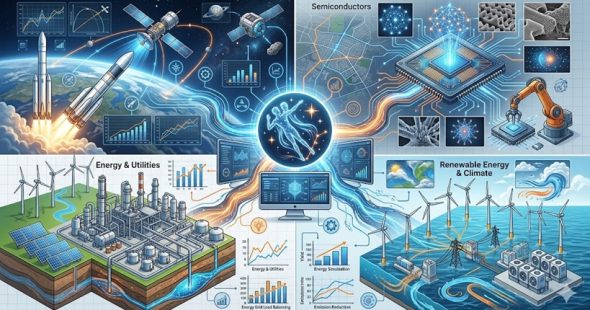
Geminus AI scales across massive, mission-critical cyber-physical systems where errors are not an option:
- Energy & Utilities: Managing and optimizing piping grids, oil/gas wells, and water distribution networks.
- Renewable Energy: Scaling up climate technologies and fine-tuning output for solar and wind energy grids.
- Aerospace & Defense: Enhancing autonomous decision-making and predictive maintenance in extreme environments like space exploration.
- Semiconductors: Accelerating high-precision chip design, boosting production yield, and minimizing time-to-market.
Did you know?
Geminus AI’s name is inspired by the Gemini constellation (the twin brothers Castor and Pollux). This embodies their core mission of creating advanced ‘digital twins’ that perfectly mirror the physical world to achieve industrial autonomy.”
Technology Focus
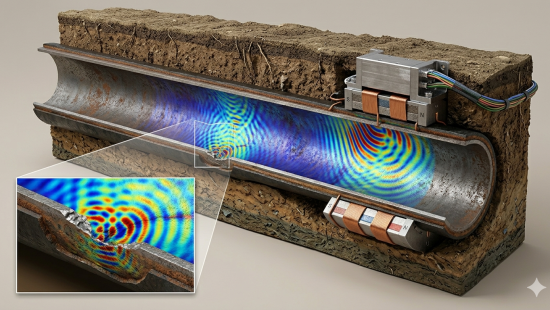
Aging pipeline infrastructure used in energy distribution, water supply, and industrial processing is vulnerable to corrosion-induced wall thinning, a form of material degradation that gradually weakens pipe walls and increases the risk of leakage or structural failure. Detecting such defects is particularly challenging in buried or embedded pipelines where direct inspection access is limited.
To study this problem, researchers at the Fraunhofer Institute for Nondestructive Testing (IZFP) investigated a simulation-based inspection approach using guided ultrasonic waves generated through electromagnetic acoustic transducer (EMAT) systems, also known as electromagnetic ultrasonic testing (EMUS).
The methodology focuses on shear-horizontal (SH) guided waves, which can travel several meters along a pipeline while remaining sensitive to changes in wall thickness. When these waves encounter corrosion-induced thinning, part of the wave energy is reflected or scattered, creating signal variations that can indicate the location and severity of damage. In cases of significant degradation, wave mode conversion may also occur, altering the reflected wave patterns.
Instead of explicitly modeling the complex EMAT hardware, the simulation represented the transducer effect through prescribed surface forces applied as line loads on the inner pipe surface in COMSOL Multiphysics. The model also implemented spatially offset and temporally phase-shifted force segments to generate unidirectional wave propagation while minimizing circumferential edge reflections.
This numerical framework aims to enable researchers to study how guided waves interact with corrosion defects and evaluate sensor configurations for nondestructive inspection of embedded pipelines.
Click to read the original article..