

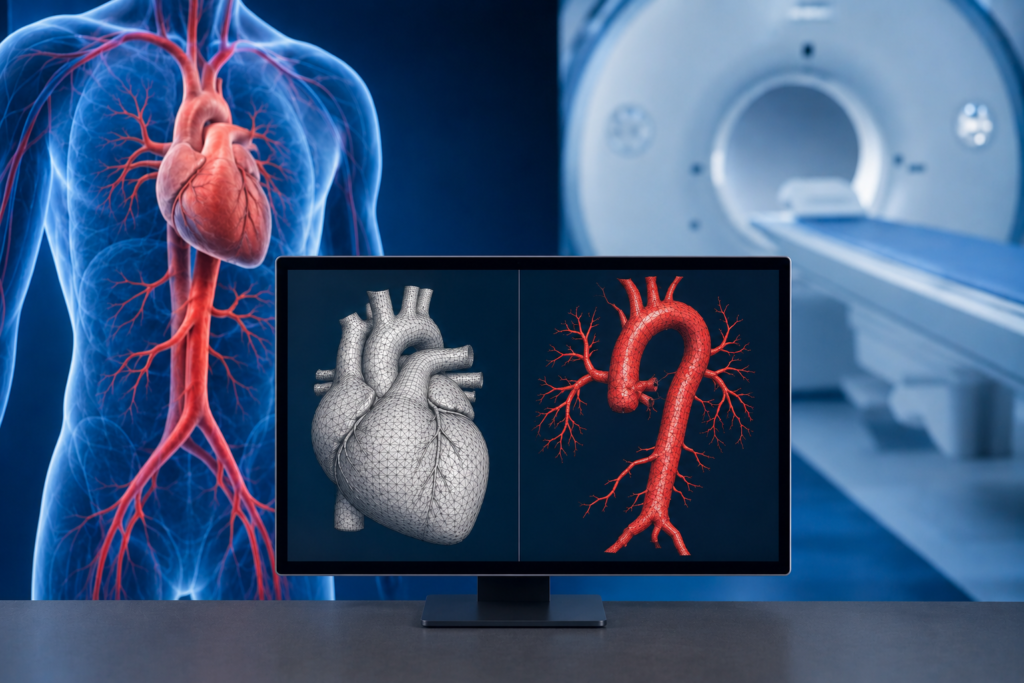
Researchers, primarily based at University of California, Berkeley, have introduced MeshGrow, a framework that aims to automatically build patient-specific 3D models of the heart and connected blood vessels from CT scans. Building these models has traditionally required extensive manual work that varies by specialist, making it difficult to study large patient groups or respond within clinical time constraints. Most existing automated tools have also addressed the heart or the vasculature separately, rather than together.
MeshGrow combines two machine learning techniques: one reconstructs the cardiac chambers, the other traces the aorta and its branches outward from the predicted aortic valve. The resulting mesh includes defined boundary surfaces suitable for CFD and finite element-based blood flow simulations. This aims to support more standardized, scalable cardiovascular simulation for research and clinical use.
Image generated by: ChatGPT