

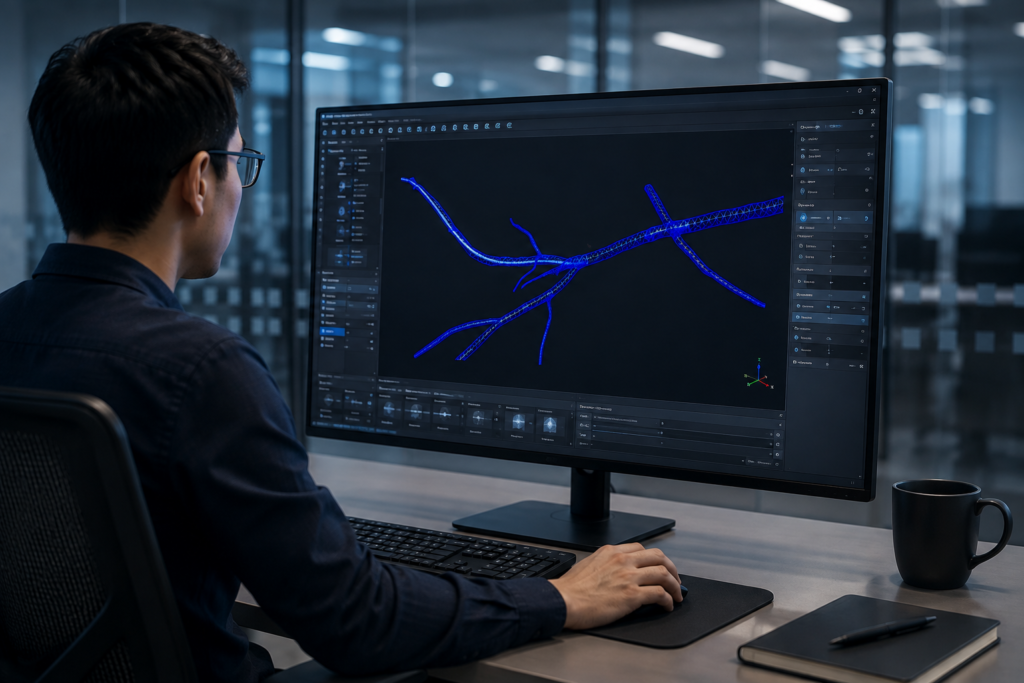
Medical robots, including surgical and catheter-guided systems, require extensive real-world-like experience before they can be used safely with patients. However, collecting diverse training data from clinical procedures is challenging, as patient anatomy varies and rare scenarios are hard to capture. To address this, NVIDIA has open-sourced Medical Physics Simulation, a GPU-accelerated framework within its Isaac for Healthcare platform. It lets developers simulate anatomy, device interactions and sensor behavior, so robotic systems can be evaluated virtually before physical testing.
The framework combines physics-based simulation with generative AI to model realistic scenarios. By making the framework openly available, NVIDIA aims to give healthcare robotics developers a common, transparent foundation for testing and validating device behavior.
Image generated by: ChatGPT