

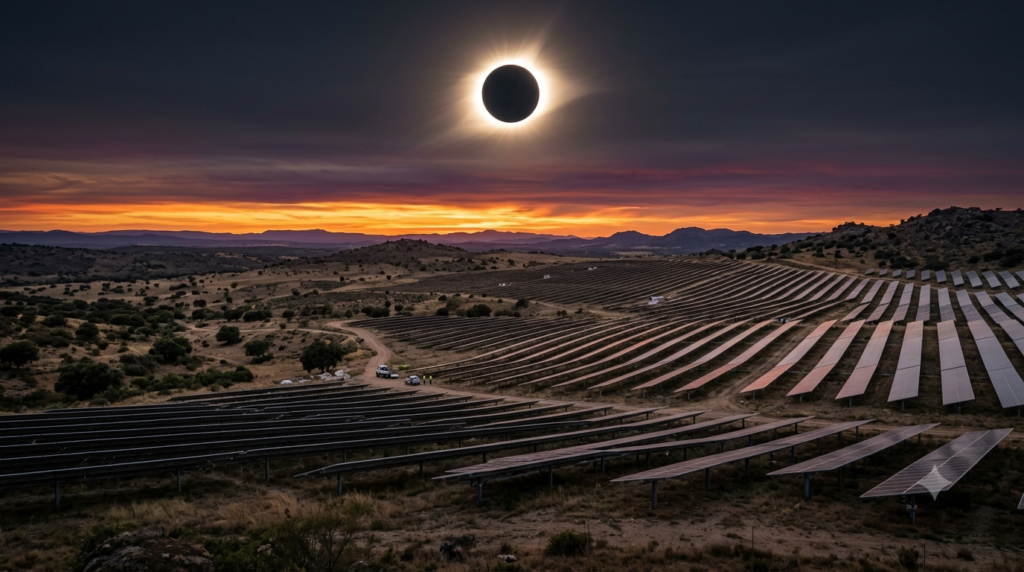
In August 2026, a rare total solar eclipse swept across Spain, briefly turning day into twilight as the Moon passed directly between the Earth and the Sun. Because the eclipse occurred in the evening, with the Sun already low on the horizon, its path of totality entered through north-western Spain and exited over the Balearic Islands, with the duration of totality varying depending on location. While skywatchers gathered to witness the spectacle, engineers saw it differently: as a real-world test for a country that increasingly relies on solar energy, since a vanishing Sun means a temporary loss of fuel for photovoltaic panels.
To explore this, engineers at Maya HTT used Siemens’ Simcenter 3D Space Systems Thermal simulation software, a tool originally built to model how spacecraft and satellites experience shifting sunlight, shadowing, and heat exposure in orbit. Applying this same approach to ground-based solar panels, they built a simplified thermal model to track how incoming solar radiation, or heat flux, changes as the Moon progressively obscures the Sun.
The simulation did not aim to predict Spain’s actual national solar power output. Doing so would require modelling thousands of individual installations, along with weather conditions and local grid behaviour, factors better suited to separate system-level simulation tools. Instead, it demonstrated the underlying physics: a rapid, forecastable dip in incoming solar radiation as the Moon’s shadow passed overhead, unlike unpredictable cloud cover.
Grid operators across Europe, and particularly in Spain, reportedly prepared in advance for a temporary decline in solar generation, while confirming there was no real risk to electricity supply. The study highlights how tools once built for spacecraft are now helping engineers understand events unfolding on Earth’s own energy grid.
Image generated by: Gemini