

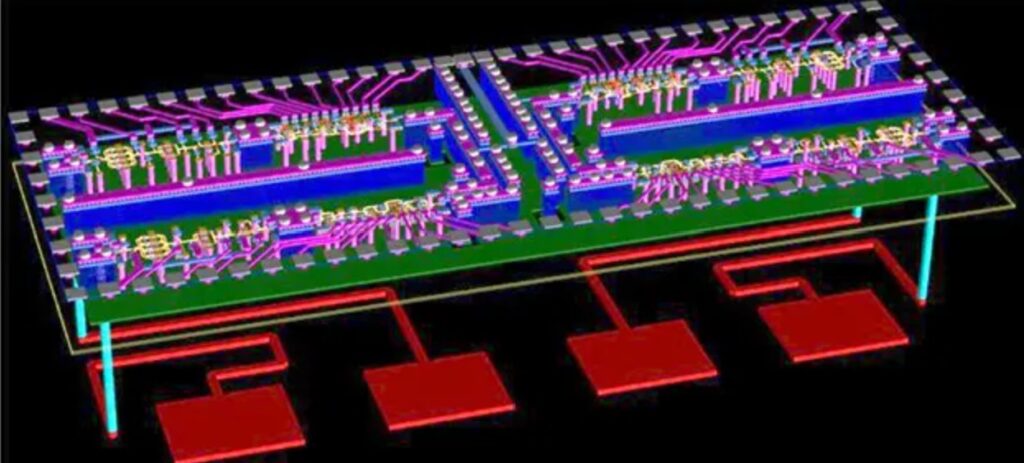
Phased arrays are groups of many small antennas that work together to send or receive radio signals in a specific direction by adjusting the timing (phase) of each element’s signal. This lets the combined antenna “steer” a beam of radio waves electronically, without moving parts, and is used in automotive radar systems, satellite communications, defence, and modern wireless systems like 5G.
The blog by Keysight explains how phased arrays work and highlights two main types: Passive Electronically Scanned Arrays (PESA) and Active Electronically Scanned Arrays (AESA), which differ in architecture and how each element is powered and controlled. It outlines key functions such as directing beams, shaping radiation patterns, and creating multiple beams simultaneously. It also discusses design complexities like accounting for interaction between elements, manufacturing variations, and carrying out comprehensive verification across many beam directions.
To address these challenges, designers rely on electromagnetic (EM) simulation tools to model how waves behave in and around the array, including full-wave EM solvers that capture mutual coupling and radiation effects. They also use circuit-level behavioral models for amplifiers and phase shifters to evaluate performance under real operating conditions, and statistical analysis methods to assess sensitivity to manufacturing tolerances. Combining EM simulation with system-level time-domain and frequency-domain analysis helps predict array behavior before hardware prototypes are built.
Image courtesy: Keysight