

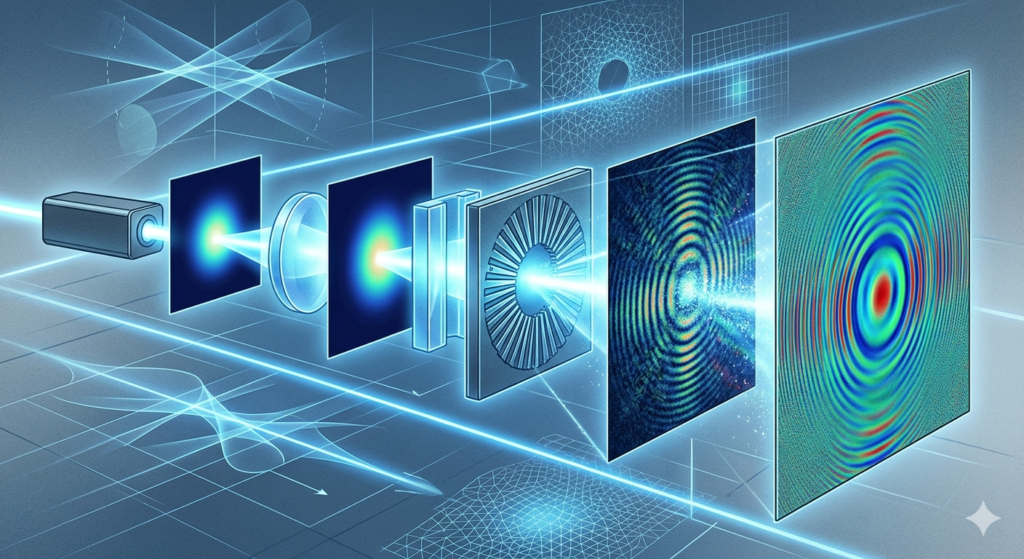
Modern optical systems such as laser scanners, LiDAR, telescopes, and fiber optics involve complex light behaviors like diffraction, interference, and wavefront evolution that conventional ray tracing methods often fail to capture accurately. This is where physical optics simulation becomes essential.
CODE V, an optical design software by Keysight, offers Beam Synthesis Propagation (BSP) as one of its physical optics simulation methods. BSP works by breaking down the optical field into beamlets, propagating each independently, and recombining them to reconstruct the field at target surfaces. This approach allows analysis of:
- Gradient-index (GRIN) materials, birefringent components, and non-sequential optical paths
- Speckle effects, interferometry fringes, and diffractive optical element (DOE) zone behavior
- Mid-spatial frequency surface errors and their impact on PSF and MTF
- Ghost peak irradiance and longitudinal Point Spread Functions
BSP also includes a Pre-Analysis feature that aims to recommend simulation parameters suited to a given lens system, making it a broadly applicable method across diffraction-critical optical design workflows.
Click to read the original article..
Image generated by: Gemini