

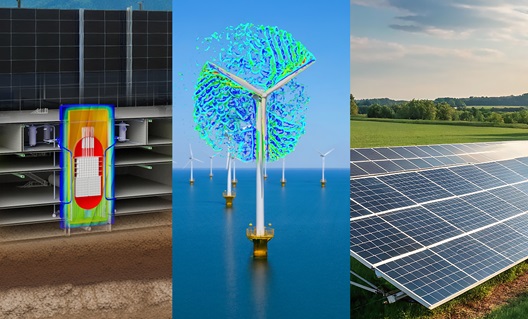
The global demand for electricity continues to grow, increasing pressure on the energy sector to develop cleaner, more reliable, and scalable energy systems. The blog by Katie Corey from Dassault Systèmes discusses how simulation technologies are helping accelerate innovation in sustainable energy development. As countries invest in low-emission energy sources such as renewable power and advanced nuclear systems, engineering teams must address growing system complexity while maintaining safety, efficiency, and cost control.
Emerging energy technologies and design complexity
The transition toward sustainable energy is introducing several advanced technologies that present new engineering challenges:
Fusion energy: Components must withstand intense neutron bombardment and extreme thermal loads. Simulation allows engineers to evaluate materials and cooling strategies under these demanding conditions.
Small Modular Reactors (SMRs): These next-generation nuclear systems aim to deliver safer and more flexible energy generation, but their design requires careful optimization to meet strict regulatory and safety standards.
Offshore wind turbines: Structures must operate reliably in harsh marine environments influenced by dynamic wind patterns, ocean waves, and long-term structural fatigue.
Hybrid energy systems: Integrating renewable power with technologies such as hydrogen production introduces multiphysics challenges involving electrical, thermal, mechanical, and fluid interactions.
Challenges shaping the energy transition
The engineers developing sustainable energy systems must also navigate several industry-wide constraints:
Faster development timelines for new technologies
Evolving environmental and safety regulations
Rising material costs and supply-chain disruptions
Increasing multidisciplinary design complexity
The need to expand energy infrastructure and grid capacity
Simulation plays a critical role in addressing these challenges by enabling engineers to analyze system behavior and test design alternatives in virtual environments before building physical prototypes. Blog also highlights the role of MODSIM (Modeling and Simulation) in modern engineering workflows. By integrating modeling and physics-based simulation within a unified environment, MODSIM enables engineers to evaluate performance earlier in the design process and improve decision-making. This approach supports the development of virtual twins, digital representations that replicate the behavior of real energy systems across their lifecycle and help organizations design more efficient and resilient sustainable energy solutions.
Image courtesy: Dassault Systèmes