


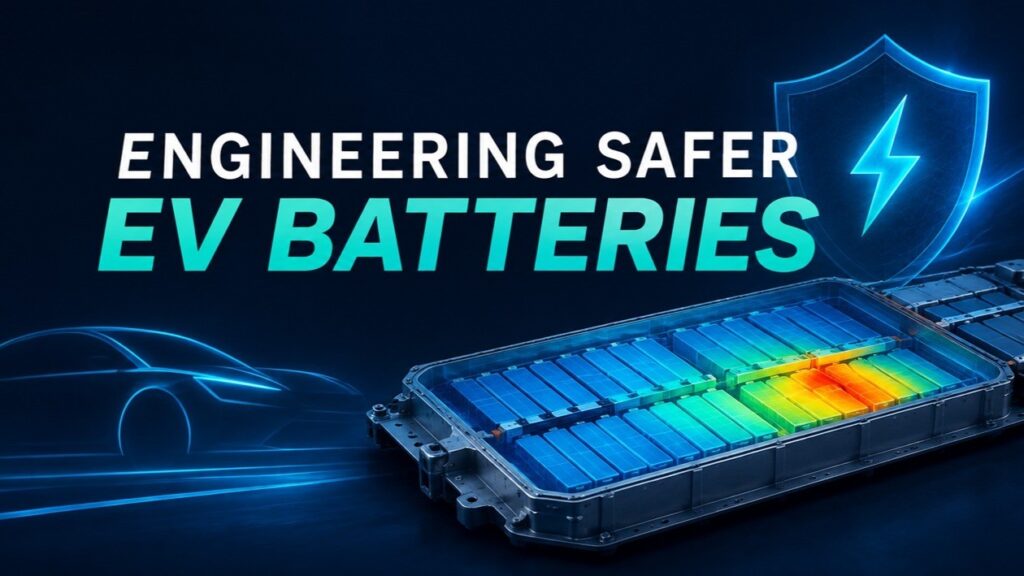
Why Predicting Battery Failure Requires More Than Physical Testing
Introduction
Every time an electric vehicle catches fire, the incident attracts attention far beyond the vehicle itself. Questions quickly follow: Are EV batteries safe? What causes a battery to fail? And can engineers predict such failures before they happen?
These questions become more important as EV adoption grows. A battery pack is expected to perform reliably through years of charging and discharging, rapid charging, changing weather conditions, road vibrations and, in extreme cases, collisions. Yet within the pack, hundreds or even thousands of cells must operate within carefully controlled electrical and thermal limits. A problem that begins in a single cell can, under certain conditions, propagate through the pack with potentially serious consequences.
The engineering challenge, therefore, is not simply to build a battery that stores more energy. It is to understand how that battery will behave across thousands of operating and failure scenarios; many of which engineers would rather explore virtually than discover on the road. It is as much as a system and software engineering problem (along with the battery management software) as much it is a component engineering problem.
Why Are EV Batteries So Difficult to Engineer?
EV battery engineering involves a difficult balancing act. Manufacturers want batteries that store more energy, provide longer driving ranges, charge faster, last longer and remain affordable while meeting stringent safety requirements. Improving one characteristic can influence several others, making battery development a multidimensional engineering challenge.
Temperature is central to this challenge. Batteries generate heat during charging and discharging, particularly under demanding operating conditions and fast charging. Engineers must therefore manage not only the overall temperature of the battery pack but also temperature variations between individual cells. Excessive or uneven temperatures can affect performance, accelerate degradation and, under abnormal conditions, contribute to safety risks.
The challenge also changes with time. Repeated charge-discharge cycles, temperature exposure and operating conditions gradually alter battery characteristics. A battery that performs predictably when new may behave differently after years of use, requiring engineers to consider safety and performance across the entire battery lifecycle.
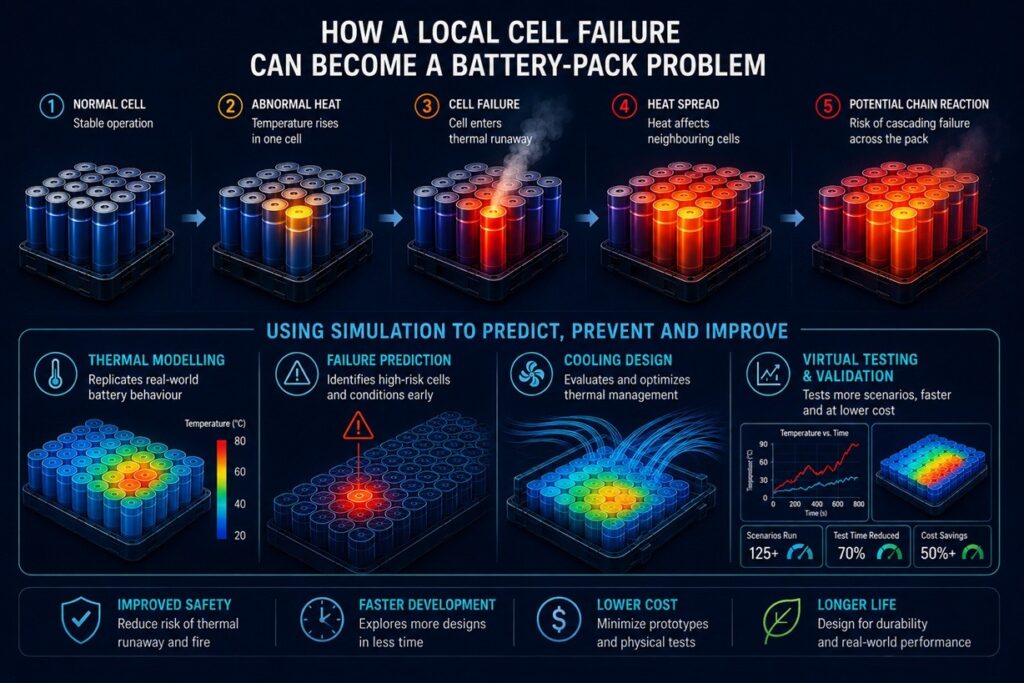
Perhaps the most demanding scenario occurs when something goes wrong. A defect, internal short circuit, overheating or mechanical damage can cause a cell to release heat rapidly causing a chain reaction. This chain reaction, known as thermal runaway, can spread from one cell to neighboring cells and potentially affect the entire battery pack.
Engineers therefore face a difficult question: How do you evaluate thousands of combinations of temperature, charging conditions, ageing, cell faults and crash scenarios before a vehicle ever reaches the road?
Why Physical Testing Alone Is Not Enough

Physical testing remains essential to battery development. Cells, modules and complete battery packs must be tested under different operating, environmental and failure conditions to validate their safety and performance. But physical testing has practical limitations.
Consider the number of conditions engineers may need to investigate: different temperatures, charging rates, states of charge, battery ages, cell defects, cooling-system failures and crash scenarios. Testing every possible combination physically would require enormous numbers of test samples, considerable time and significant cost. Some destructive safety tests are also difficult to repeat consistently.
More importantly, physical tests usually show engineers what happened. Understanding exactly why it happened can be more difficult. What caused one cell to overheat first? How did heat travel through the pack? Why did a neighboring cell remain stable in one test but fail in another?
This is where virtual testing becomes particularly valuable. Engineers can investigate conditions that would be expensive, time-consuming or difficult to reproduce physically, while using physical tests to validate whether their models accurately represent real battery behavior.
The question is no longer physical testing or simulation—it is how effectively the two can work together.
How Simulation Helps Engineers Look Inside the Battery
Understanding heat before it becomes a problem
Thermal models allow engineers to study how heat is generated and distributed across cells, modules and the complete battery pack under different operating conditions. Engineers can compare cooling strategies, identify potential hot spots and evaluate whether cells remain within acceptable temperature ranges.
Exploring failure without destroying hundreds of batteries
Simulation can also help engineers investigate abnormal conditions, such as internal short circuits, cooling-system failures or damaged cells and study whether the resulting heat remains localized or spreads to neighboring cells.
This becomes particularly important when examining thermal runaway, where engineers need to understand not only how a cell fails, but how the pack responds once that failure begins.
Designing for fast charging
Fast charging creates another difficult trade-off. Drivers want shorter charging times, but higher charging rates can increase heat generation and contribute to battery degradation.
Simulation allows engineers to explore different charging strategies and cooling approaches virtually before committing to hardware changes.
Looking beyond a new battery
Battery models can also help engineers study how performance changes as cells age. By combining electrochemical, thermal and ageing models, engineering teams can investigate how repeated charging, temperature exposure and operating conditions may influence battery behavior over its lifetime.
Preparing the battery for a crash
Battery safety isn’t only an electrical or thermal problem. In a collision, deformation of the vehicle structure can damage cells or electrical connections.
Structural and crash simulation can help engineers study how forces travel through the battery enclosure, where deformation may occur and how effectively the pack protects its cells.
Battery safety therefore cannot be understood through a single simulation. Thermal behavior, Electrical performance, ageing, structural integrity and cooling are interconnected. Increasingly, engineers are combining these different models to understand how the battery behaves as a complete system; across normal operation as well as extreme conditions.
From Simulation to Battery Intelligence
Simulation is no longer confined to predicting battery behavior during the vehicle design stage. A growing group of companies and research organizations is combining physics-based modelling, real-world battery data and predictive analytics to understand how batteries perform and age throughout their lifecycle.
For example, India based Fawkes Energy is developing battery-intelligence tools that combine physics-based models with real-world operating data. Its work focuses on areas such as State of Health (SoH), Remaining Useful Life (RUL), degradation and battery lifecycle decisions. Interestingly, its approach extends the role of modelling beyond vehicle development into areas such as fleet operation, resale and second-life applications.
UK-based About:Energy takes a somewhat different approach, providing electrothermal battery models that predict electrical behavior and internal temperature together. Such models allow engineering teams to investigate thermal behavior and cooling strategies before committing to physical hardware.
At the safety end of the spectrum, RISE Research Institutes of Sweden combines Multiphysics simulation with full-scale battery testing to study thermal runaway and how a failure can spread from one cell through a battery system. This is a useful example of an important point: simulation does not eliminate physical testing; the two strengthen each other.
Together, these examples show how battery modelling is evolving—from a design tool into a means of understanding performance, safety, ageing and ultimately the entire battery lifecycle.
Looking Ahead: From Predicting Failure to Preventing It
Battery engineering is gradually moving from understanding failures after they occur to predicting the conditions that could lead to them. As battery models become more sophisticated and are combined with data generated during testing and real-world operation, engineers can gain a clearer picture of how a battery may behave not only today, but years into its life.
This could become increasingly important as EV batteries are pushed harder. Faster charging, higher energy densities, longer vehicle lifetimes and second-life applications all introduce new variables into an already complex engineering problem. The challenge is no longer simply to validate whether a battery is safe under a prescribed set of test conditions, but to understand how its safety margins may change across different operating conditions and over time.
Simulation will not eliminate physical testing. Instead, its value lies in helping engineers decide what to test, where to look and which scenarios deserve closer investigation. Physical tests can then provide the evidence needed to validate and refine those predictions.
Conclusion
EV battery safety is not defined by a single test, technology or engineering discipline. It depends on understanding how cells and battery packs behave across different temperatures, charging conditions, states of health and unexpected events. As batteries become more powerful, charge faster and remain in service longer, the number of conditions engineers need to evaluate will only increase.
Physical testing will continue to be essential, but it cannot practically explore every possible operating and failure scenario. Simulation complements testing by allowing engineers to investigate a much wider range of conditions, identify potential risks and focus physical validation where it matters most. The real value lies not in choosing between physical and virtual testing, but in using each to strengthen the other.
As battery technology evolves, simulation’s role may increasingly shift from helping engineers understand why failures occur to helping them anticipate where and when they could occur—long before those conditions are encountered on the road.
Ref:
1. Fawkes Energy: https://fawkesenergy.com/
2. About:Energy: https://www.aboutenergy.io
3. RISE Research Institutes https://www.ri.se/en
Images generated by: ChatGPT