Electric motors used in electric vehicles can produce unwanted noise and vibration due to electromagnetic excitation inside the motor. Two major sources are torque ripple and stator tooth forces. Torque ripple refers to small periodic fluctuations in the motor’s output torque instead of perfectly smooth rotation. Stator teeth are the protruding parts of the stator core that hold the windings and interact with the rotor’s magnetic field. As the rotor rotates, changing magnetic forces act on these teeth, creating vibration. Rotor torque is the rotational force generated by the rotor as electromagnetic fields interact between the stator and rotor.
The blog by AVL describes a simulation workflow used to analyze these effects early in the design phase. First, AVL E-Motor Tool calculates electromagnetic quantities such as rotor torque, torque ripple, and stator force harmonics based on the motor geometry, winding configuration, and operating conditions. These calculated electromagnetic excitations are then transferred to AVL EXCITE™ M, a multi-body dynamics simulation tool used to study the mechanical response of the motor system.
In EXCITE M, engineers analyze how electromagnetic forces excite the motor structure and lead to NVH (noise, vibration, and harshness) behavior. The simulation aims to help identify critical excitation frequencies, resonance effects, and structural vibration modes in the motor housing or drivetrain components. The workflow can also evaluate factors such as rotor eccentricity, skewing of rotor/stator laminations, and PWM inverter excitation, which influence vibration behavior. By combining electromagnetic and mechanical simulations, engineers can better understand the sources of e-motor noise and assess design changes to mitigate NVH issues during development.
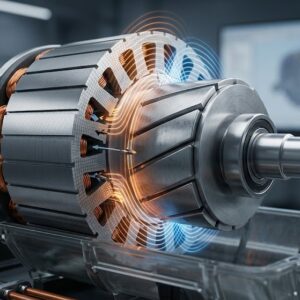
Image generated by: Gemini