


Two identical EVs roll off the production line. They have the same battery, powertrain and thermal-management systems, and are expected to deliver similar performance. A few years later, however, they may be quite different vehicles. One may have experienced frequent fast charging, heavy urban traffic and high ambient temperatures, while the other may have operated under relatively moderate driving and charging conditions. Their batteries may have aged differently, and their powertrain and thermal systems may have accumulated very different operating histories.
Engineering models and simulation help predict how these systems are expected to behave when the EV is designed. Once the vehicle enters service, real-world operating data adds another dimension. A digital twin brings the two together—connecting virtual models with information from the physical EV so that its digital representation can reflect how the vehicle and its subsystems are actually behaving and changing over time.
The EV and its Digital Subsystems
An EV operates through several closely connected systems, each responding differently to driving conditions, temperature, charging and ageing. This makes the subsystem level particularly relevant for digital twins, as changes within one system can influence the performance and condition of others.
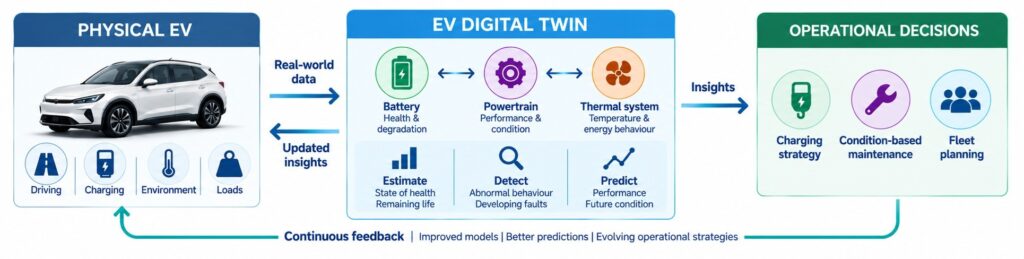
The battery is perhaps the clearest example. Its condition cannot be understood from a single measurement. Voltage, current, temperature, charging history and usage patterns can be combined with battery models to estimate parameters such as State of Charge (SoC), State of Health (SoH) and degradation over time. Unlike a model representing a new battery under predefined conditions, a battery digital twin can evolve with operating data and provide a picture of how that particular battery is changing through its life.
A similar approach can be applied to the electric powertrain. Operating data from the motor, inverter and associated systems can be compared with expected behavior. Changes in this relationship can provide insight into performance and may help identify signs of component degradation or developing faults before they become more evident.
Thermal management adds another dimension because temperature affects several EV systems simultaneously. Battery performance and ageing are temperature-dependent, while the motor and power electronics also need to remain within suitable operating ranges. At the same time, heating and cooling consume energy and therefore influence efficiency and range. Connecting thermal models with actual operating and environmental data can provide a more realistic understanding of these interactions.
The significance lies in bringing these different views together. Battery condition influences charging and available performance; thermal conditions affect battery life and powertrain efficiency; and driving patterns influence all of them. Digital twins at subsystem level can therefore provide complementary views of the condition and behavior of the EV as a whole.

From Digital Twin to EV Operations
Understanding the condition of an EV is useful only when that information can support better decisions. This is where the digital twin can move beyond monitoring and become relevant to vehicle operation.
Charging is one example. Two EVs with the same nominal battery capacity may no longer have batteries in the same condition after several years of use. Their temperature, health, charging history and degradation may differ. Information from a battery digital twin can help account for these differences when assessing battery condition and charging behavior, rather than treating every battery of the same type as identical throughout its life.
Maintenance presents another opportunity. Conventional diagnostics generally identify a problem once predefined limits or fault conditions are reached. A digital twin provides an additional reference: the behavior expected from the model. If actual behavior begins to deviate from that expectation, the change may provide an early indication of degradation. For batteries, motors and power electronics, this can support a gradual shift from responding to faults towards condition-based and predictive maintenance.
The same principle becomes useful at fleet level. An operator managing hundreds of EVs does not only need to know whether individual vehicles are running. Information about battery condition, component health and charging requirements can help identify vehicles requiring attention, plan maintenance and coordinate charging around operational needs.
As EVs become more connected to charging infrastructure and energy networks, vehicle-specific information could also contribute to smarter charging and, eventually, vehicle-to-grid applications. The focus remains the same: using knowledge of the actual condition and behavior of the EV to make better decisions around its operation.
Connecting the Digital Twin
The idea of an integrated digital twin of an EV is attractive, but connecting these individual views is not straightforward. Battery, powertrain and thermal models represent different physical phenomena, work at different timescales and may require very different levels of computational detail. Creating a useful whole-vehicle representation means bringing these models and their data together without making the system impractical to operate.
The quality of the twin also depends on the quality of the information feeding it. Sensor accuracy, data availability, connectivity and model fidelity all influence how closely the virtual representation can reflect the physical vehicle. Interoperability between models and systems, computational requirements, data management and cybersecurity add further challenges.
For this reason, digital twins of individual EV subsystems are currently a more practical proposition than an all-encompassing, continuously updated digital twin of every aspect of the vehicle. The progression towards a more integrated EV twin will depend not simply on creating more models, but on connecting the right models and data in a way that provides useful engineering and operational insight.
When the Virtual Vehicle Evolves with the Physical One
The two EVs that began their lives identically may look similar several years later, but their operating histories can tell very different stories. Their batteries may have aged differently, their components may show different levels of degradation, and their charging and maintenance needs may no longer be the same.
This is where the digital twin can add value. By allowing the virtual representation to evolve with the physical EV, it can help turn operating data into an understanding of how the vehicle is changing and what that could mean for its future performance. As individual subsystem twins become better connected, that understanding can extend from the battery or powertrain to the vehicle as a whole.
Ultimately, the promise of an EV digital twin is not to create a perfect virtual copy of the vehicle. It is to maintain a meaningful connection between the vehicle that was designed and the vehicle that actually exists on the road throughout its operating life.