


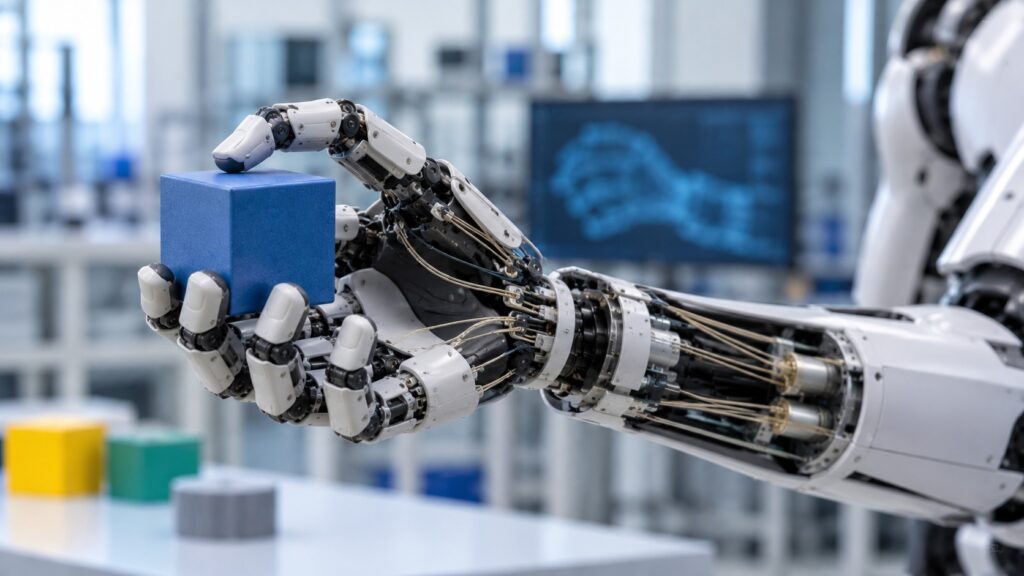
A humanoid robot creates value only when it can interact with the physical world, such as grasping objects, turning a valve, or operating a tool. These tasks depend on the robotic hand, a complex system.
The human hand inspires many designs. Many of the muscles moving the fingers sit in the forearm and act through tendons, and numerous humanoid hands place motors in the palm or forearm, transmitting force through cables, ropes, or Bowden mechanisms. Yet every choice affects another: a larger motor can add weight, heat, and battery demand, while smaller fingers may complicate tendon routing and cooling.
System simulation examines these interactions together. Using Siemens’ Simcenter Amesim, engineers can build a digital twin of the hand before any prototype exists, combining ropes, actuators, motors, controls, friction, and power needs in a shared model. Applications include validating finger motion and grasping, identifying where friction causes force losses, sizing motors from realistic operating scenarios, estimating battery state of charge, and evaluating thermal behaviour.
This shifts questions from component performance toward missions, such as whether a hand can handle varied object shapes, common grasps, or repeated valve operation through a shift. Such system-level evaluation aims to support earlier, informed design decisions as robotic hands work toward human-like manipulation.
Click to read the original article..
Image generated by: ChatGPT