


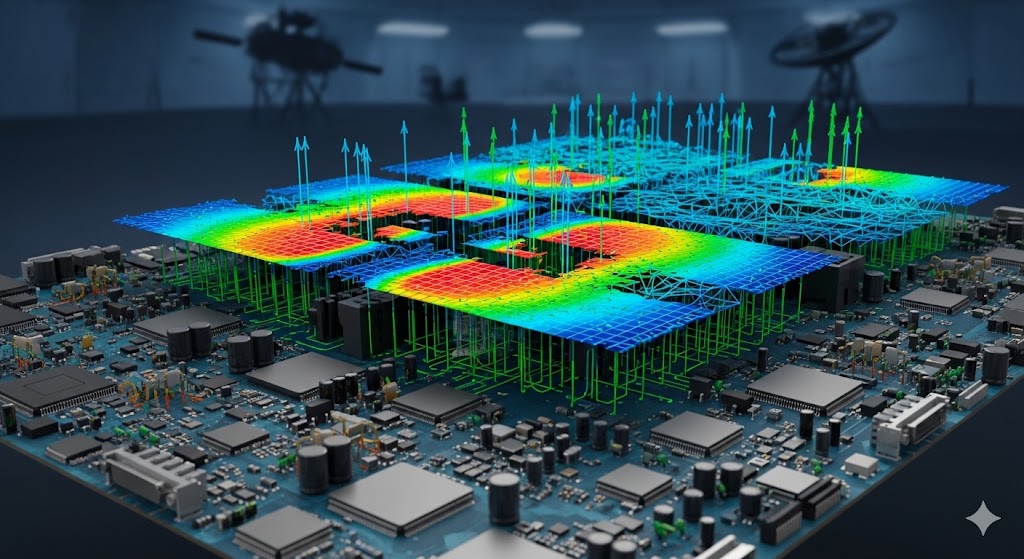
In defense electronics, PCB (Printed Circuit Board) validation is not limited to functional performance but extends to ensuring long-term reliability under mission-critical conditions such as vibration, thermal cycling, and mechanical shock. Hardware qualification typically depends on building and testing multiple PCB prototypes, where issues such as solder fatigue or thermal overstress are often detected only after environmental testing, leading to rework and schedule delays. ANSYS Sherlock is used to shift this process earlier by enabling reliability prediction directly from design data using physics-of-failure analysis.
The workflow enables engineers to:
- Import ECAD designs and rapidly convert them into simulation-ready models
- Evaluate failure mechanisms including solder fatigue, vibration-induced damage, thermal stress, and CAF risks
- Replicate defense-relevant environments such as shock, humidity, and temperature variations
- Reduce reliance on multiple hardware prototypes and compress validation timelines
As highlighted in the blog by Corengg Technologies, this approach supports a more design-centric and predictive method for PCB reliability validation in defense applications.
Click to read the original article..
Image generated by: Gemini