


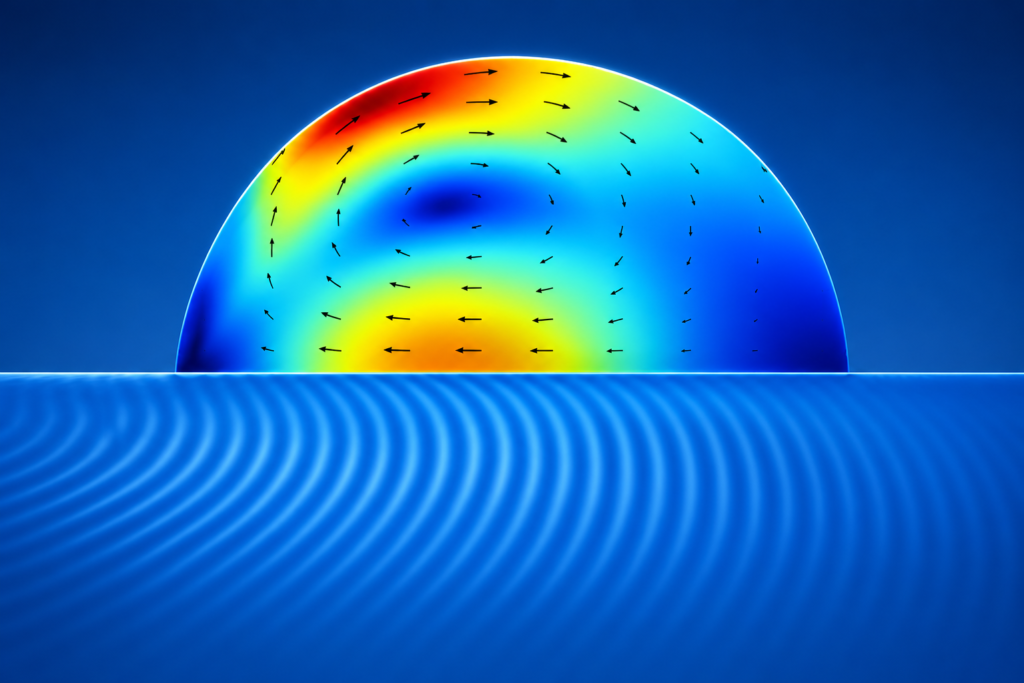
Surface acoustic waves can create a steady circulating flow inside a tiny droplet, offering a way to mix fluids without touching them. The blog by COMSOL explains how this streaming effect can be modeled from start to finish using the COMSOL Multiphysics® software, starting with an alternating voltage applied to a piezoelectric surface through comb-like electrodes. This generates waves that travel along the surface and, upon reaching a droplet, leak energy into it. Inside the droplet, these waves reflect and gradually lose energy through viscous effects, which aims to produce a continuous circulating motion known as acoustic streaming.
Because this process involves several interacting physics areas, such as electric fields, structural vibration, acoustics, and fluid flow, simulations are often built in stages. A simplified two-dimensional model helps confirm the basic behavior, while a fully three-dimensional model captures the true shape of the flow more accurately, though it demands greater computational effort and careful handling of memory and mesh design. Together, these steps provide a practical framework for studying acoustic streaming in droplets.
Image generated by: ChatGPT