


In some ultra-luxury watches, a minute repeater uses tiny hammers striking tiny gongs to chime the hours, quarter-hours, and minutes on demand. Originally created to tell time in the dark, it is now regarded as a piece of art, representing status, craftsmanship, and a link to the past.
Achieving just the right chime tones takes extreme precision, with multiple small components involved. To study this, engineers at HEPIA in Geneva, part of HES-SO University of Applied Sciences and Arts Western Switzerland, used COMSOL Multiphysics® and a simplified 2D model.
Multibody dynamics simulated the hammer–gong interaction, including contact, spring, and damping effects. The boundary element method (BEM) calculated the radiated sound field, while the finite element method (FEM) served as a comparison. Unlike FEM, which requires meshing the surrounding air volume, BEM meshes only the boundaries, reducing computational and memory demands. Researchers also used a deep neural network surrogate model trained on BEM simulation data, together with the efficient global optimization algorithm, to explore hammer impact positions and their effects on acoustic intensity and tonal quality.
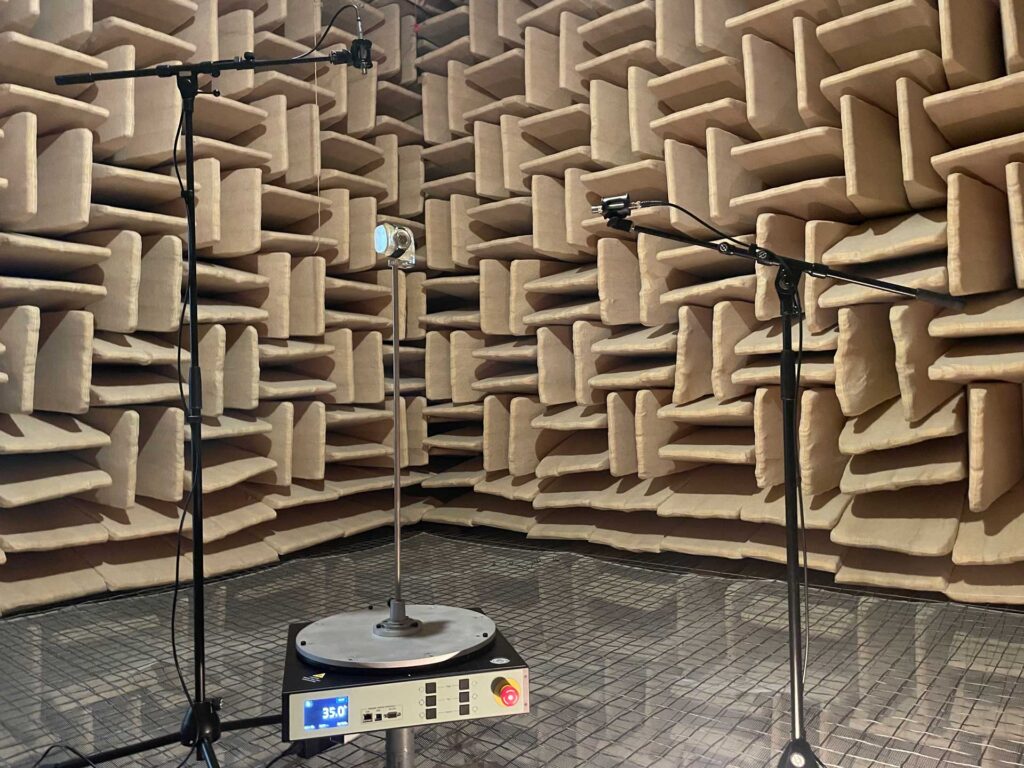
Researcher Roland Rozsnyo explained that the boundary element method gave similar acoustic results with substantially reduced computation, and that surrogate modeling notably shortened optimization time. Results are validated against measurements in HEPIA‘s anechoic chamber. He sees the watch industry as only at the beginning of using multiphysics simulation, suggesting this timeless tradition still has much to explore.
Image courtesy: Comsol