


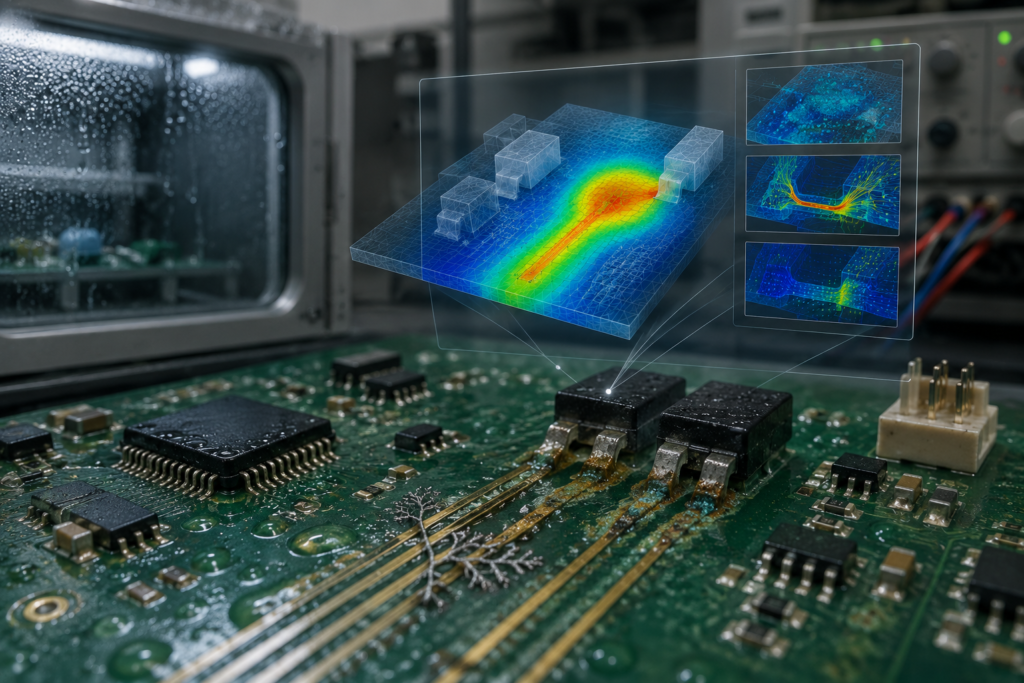
Researchers at the Centre for Electronic Corrosion (CELCORR) at the Technical University of Denmark (DTU) are using COMSOL Multiphysics to investigate how humidity can contribute to failures in high-voltage electronics, including systems used in electric vehicles, wind turbines, solar installations, and data centers. Moisture condensation on PCB surfaces can trigger corrosion and electrochemical migration (ECM), leading to leakage currents and dendrite-induced short circuits. Because moisture can evaporate without leaving visible evidence, the root cause of such failures is often difficult to identify.
CELCORR, together with Aalborg University and industry partners, has developed simulation apps that aims to allow engineers to vary PCB design parameters, including electrode geometry, water-film thickness, and electrolyte conductivity, to evaluate susceptibility to humidity-induced failures during the design stage. Supported by a grant from the Grundfos Foundation, CELCORR has also established the Centre for Climate Robust Electronics Design (CRED) to extend this research to high-power, high-voltage systems.
Image generated by: ChatGPT