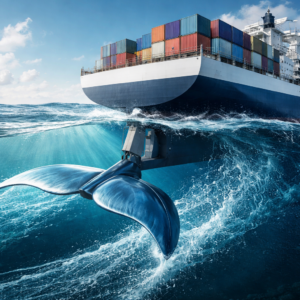

For many years, the maritime industry has depended on engineering to improve efficiency, but today, some of the most innovative ideas are inspired by marine life. One such example is Bluefins’ whale-inspired energy-recovery propulsion concept, which draws on the natural motion of whale fins to improve how ships move through water.
Instead of relying solely on conventional propellers, the system introduces a hydrofoil positioned at the stern of a vessel. As the ship travels through waves, the foil moves in response to water motion, generating additional thrust from energy that would otherwise dissipate. In effect, it converts wave-induced motion into useful propulsive force, helping reduce fuel consumption and overall operating costs.
A key part of the development process has been the use of advanced computational fluid dynamics tools, including Cadence’s Fidelity CFD platform, specifically Fidelity Fine/Marine for flow simulation and Fidelity Pointwise for high-quality mesh generation. These tools were applied to simulate complex free-surface flows, hull–foil interactions, and vessel motions in realistic sea conditions. By running detailed virtual analyses, engineers could study how the hydrofoil behaves under varying wave patterns and operating scenarios without relying solely on physical prototypes.
The concept reflects a broader shift in marine innovation: combining bio-inspired design with high-fidelity simulation. As shipping faces increasing pressure to operate more efficiently and sustainably, such hybrid thinking may become an important part of the industry’s evolving toolkit.
Image generated by: ChatGPT