


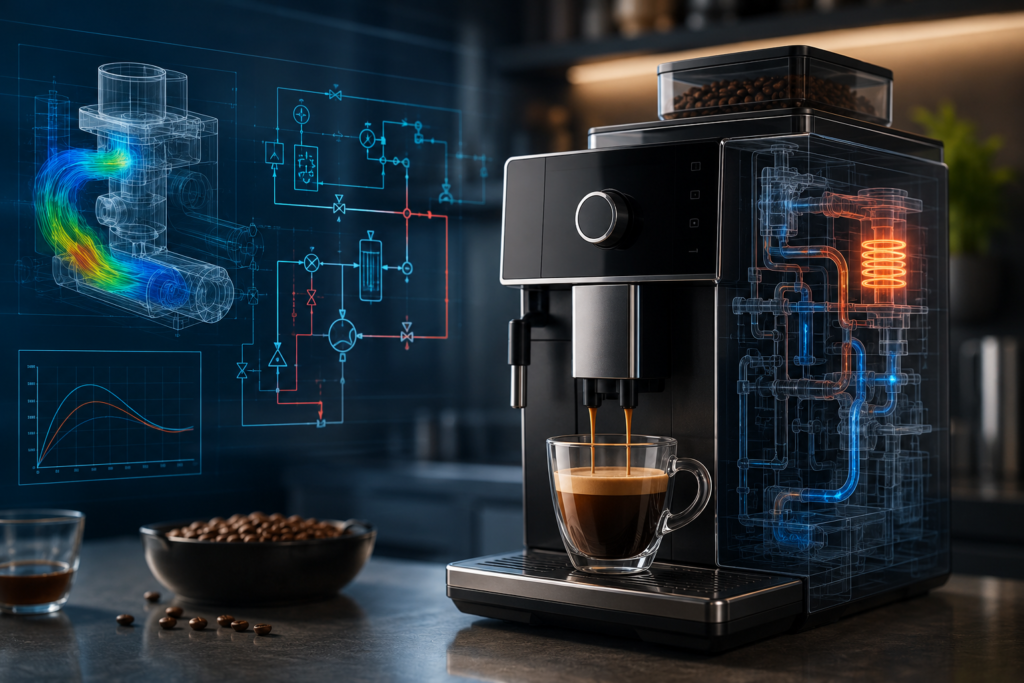
Engineering a coffee machine that consistently delivers on taste, energy efficiency, and sustainability is more complex than it may seem. BSH Home Appliances, a Bosch Group subsidiary whose brand portfolio includes Bosch, Siemens, Gaggenau, and Neff, has been using simulation technologies to better understand and manage that complexity.
Behind every cup of coffee is a complex interaction of water flow, temperature, pressure, and control systems. Small changes in any of these variables can affect brewing performance, energy consumption, and overall machine behavior. While physical testing remains essential, it can be difficult to fully capture the transient conditions that occur during startup, heating, and pumping cycles.
To address this, BSH has incorporated Siemens’ Simcenter STAR-CCM+ and Simcenter Amesim into its development workflow. Engineers use STAR-CCM+ to analyze fluid flow and heat transfer within individual machine components, while Amesim is used to model the behavior of the complete system and evaluate different operating and control strategies. The simulation environment is also used to assess the impact of production changes, such as modifications to hose length, before they are introduced into physical products.
Through this approach, BSH is able to explore how changes in temperature, pressure, and system design influence brewing performance before committing to physical prototypes, providing engineers with greater insight into the factors that ultimately shape the quality of the final cup.
Click to read the original article..
Image: ChatGPT