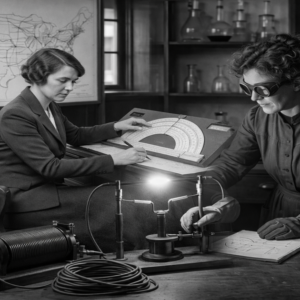
Hertha Ayrton (1854–1923)
The Physicist of the Electric Arc and Fluid Dynamics
Hertha Ayrton was a British engineer and mathematician who transformed our understanding of electricity and fluid mechanics. At a time when women were rarely allowed into scientific societies, she became the first woman to win the Hughes Medal for her original research.
Key Contributions:
The Electric Arc (Physics): In the 1890s, electric arc lighting was the primary source of bright light for lighthouses and streets, but it was plagued by a loud, disruptive “hissing.” Hertha proved that this was a physical phenomenon caused by oxygen reacting with the carbon rods. Her book, The Electric Arc (1902), established the mathematical relationship between power, current, and the arc’s length.
Vortex Theory (Fluid Dynamics): She turned her attention to the motion of water and air, specifically studying how “sand ripples” are formed by waves. Her research into vortices—swirling patterns of fluid—changed the way engineers understood friction and movement in liquids.
The Ayrton Fan (Structural/Fluid Engineering): During WWI, she applied her vortex theories to a life-saving invention. She designed a simple, hand-operated fan that created a specific air current to “push” heavy, poisonous mustard gas out of soldiers’ trenches. Over 100,000 of these were deployed on the Western Front.
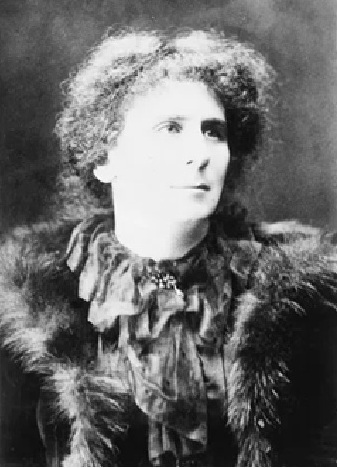
Edith Clarke (1883–1959)
The Architect of the Modern Power Grid:
Edith Clarke was a pioneer who built the mathematical “bones” of the American electrical system. She was the first woman to earn an Electrical Engineering degree from MIT and the first female professor of Electrical Engineering in the United States.
Key Contributions:
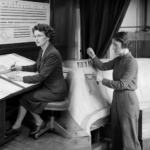
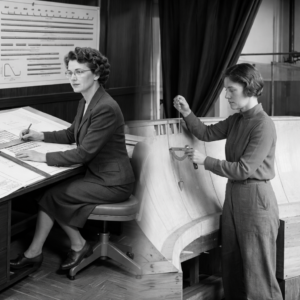
The Clarke Calculator (Electromagnetics/Design): In 1921, Edith patented a specialized graphical calculator. Before high-speed computers, calculating the performance of long-distance power lines was a grueling process. Her device allowed engineers to calculate line characteristics—including voltage and current—10 times faster than previous methods.
The Clarke Transformation ($\alpha\beta\gamma$): She developed a mathematical method to simplify the analysis of three-phase power systems (the type used to power cities). By “transforming” complex three-phase coordinates into simpler components, she made it possible to stabilize large-scale grids. This math is still a core part of power engineering curricula today.
Infrastructure & The Hoover Dam: During her time at General Electric (GE), she applied her mathematical models to massive civil works, including the hydroelectric turbines for the Hoover Dam.
Her work ensured that the electricity generated by the dam could be transmitted safely over hundreds of miles to growing cities.
“Did You Know: While Hertha Ayrton was the first woman to read a paper before the Institution of Electrical Engineers in the UK (1899), Edith Clarke became the first woman to do the exact same thing for the American Institute of Electrical Engineers in the US (1926). Even though they were separated by an ocean and 27 years, they both broke the exact same ‘silence barrier’ in the world of high-voltage electromagnetics!”