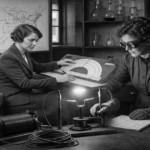
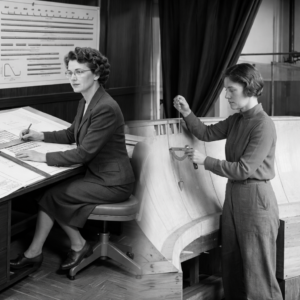
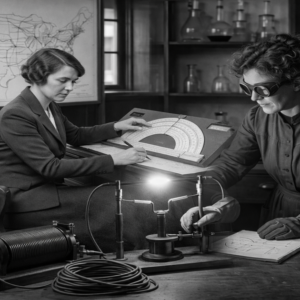
Letitia Chitty (1897–1982)
The Prodigy of Pressure
While most engineers spend years earning their stripes, Letitia Chitty was thrust into the world of aeronautics at just 20 years old. Recruited from her mathematics studies at Cambridge during the height of WWI, she became a vital “Technical Assistant” for the British Air Ministry. At an age when she wasn’t yet legally allowed to vote, she was already solving the complex differential equations that governed aircraft stability.
Letitia Chitty was a British structural engineer who spent her career calculating the “breaking point” of complex structures. She was a master of Stress Analysis, a field that predicts how much weight or pressure a structure can take before it fails.
- Aeronautical Engineering: During WWI, she worked on the structural integrity of airframes. She was tasked with analyzing the “Tarrant Tabor,” a massive experimental bomber. Her calculations correctly predicted that the aircraft was structurally unstable—a warning that was tragically ignored, leading to a crash exactly as she had modeled.
- Civil Engineering & Dams: She later moved into civil engineering, becoming an expert on Arch Dams. She developed mathematical methods to understand how the curved walls of a dam distribute the massive pressure of held-back water. Her work was instrumental in the design of the Dukan Dam in Iraq.
- The “First” Among Peers: She was the first female Fellow of the Royal Aeronautical Society and the first woman to receive the Telford Gold Medal (the highest award in civil engineering).
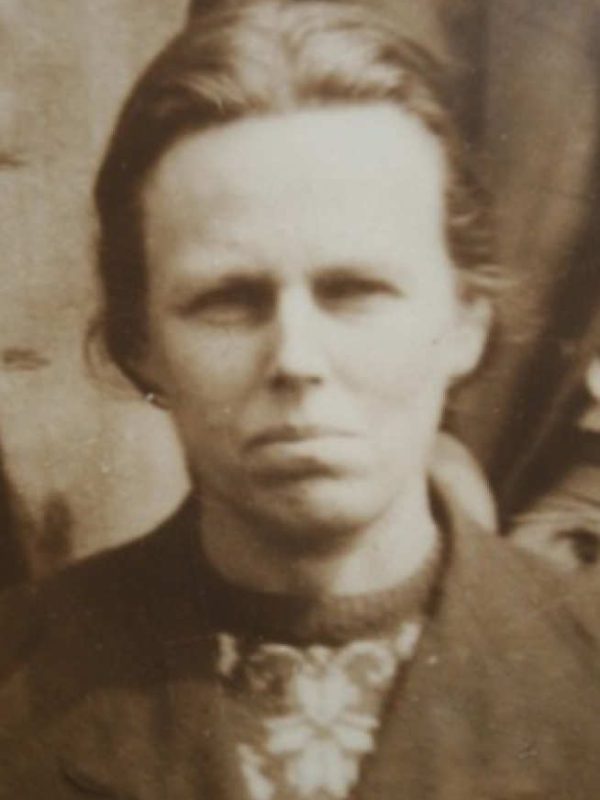
Alice Goff (1894–1972)
The Empress of Reinforced Concrete
If Letitia handled the air and water, Alice Goff handled the earth and steel. She was one of the first women in the US to earn a Civil Engineering degree (University of Michigan, 1915) and spent 45 years designing the “skeletons” of major industrial buildings.
- Structural Steel and Concrete: Alice specialized in Reinforced Concrete, a material that requires precise mathematical balancing to ensure the steel and concrete expand and contract together without cracking.
- Industrial Scale: During WWII, she was the lead engineer on the structural designs for massive military manufacturing plants. In one year alone, she performed the structural calculations for 75 different buildings.
- The Professional Barrier: At a time when women were often barred from construction sites, Alice’s calculations were so trusted that she rose to become a lead engineer at the Truscon Steel Company, a firm that built much of industrial America.
Alice Goff also authored the book “Women Can Be Engineers”, which encourages women to pursue careers in engineering.
Click here to read it ..

“Did you know:
While an ocean separated them, the math they used was identical. Letitia Chitty used ‘Strain Gauges’ to measure the pressure on dams, while Alice Goff used ‘Reinforcement Ratios’ to calculate the strength of concrete. Even if they never shook hands, they spoke the same mathematical language—a universal dialect of safety and precision that bridged the gap between London and Ohio!”