



Beyond the Battery: Why EV development has become a systems engineering challenge
Introduction
For an earlier generation, the idea that electricity could propel a vehicle across cities and highways may have seemed improbable. Today, electric mobility is reshaping not only transportation, but also how vehicles are engineered, manufactured, operated, and continuously improved. Yet the real transformation extends far beyond replacing an internal combustion engine with a battery and an electric motor. Electrification has changed the engineering challenge itself, turning vehicle development into an exercise in balancing complex interactions across mechanical, electrical, thermal, electronic, and software systems.
EVs: More Than Cars Powered by Batteries
For many people, an electric vehicle appears to be a simple concept: replace the fuel tank with a battery and the engine with an electric motor. In reality, an EV is a tightly integrated engineering system in which decisions made in one domain can quickly affect several others.
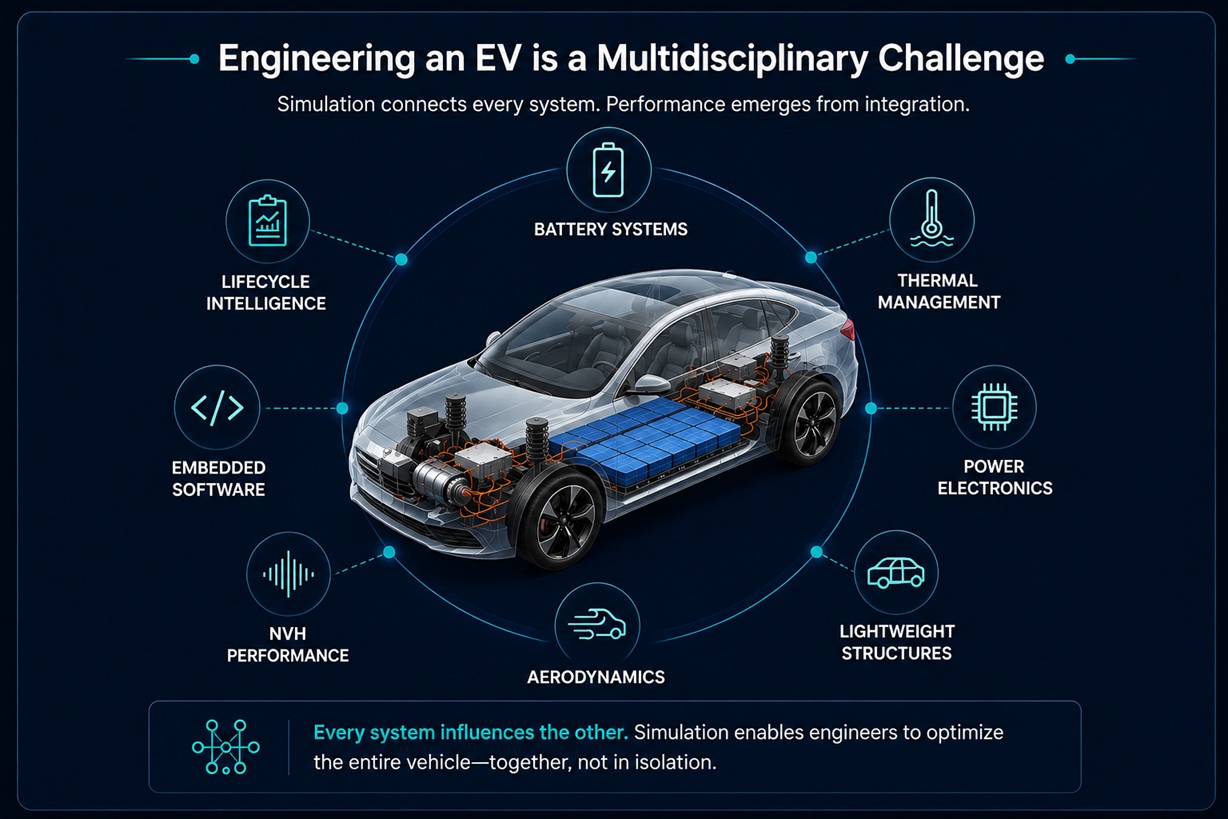
While conventional vehicles already combine mechanical, electrical, electronic, and software systems, electrification significantly increases the interdependence between them. Design decisions involving the battery influence vehicle weight, structural integrity, thermal performance, charging behavior, and software strategies for energy management. Aerodynamic choices affect driving range, cooling requirements, and battery sizing, while thermal management directly influences performance, durability, safety, and passenger comfort. Engineering decisions that were once largely confined to individual domains now ripple across the entire vehicle.
This tight coupling creates unavoidable trade-offs. Increasing battery capacity may improve range, but it also adds mass, affects crash behavior, increases thermal loads, and changes charging requirements. Faster charging may improve convenience, but it can intensify heat generation and accelerate battery degradation. Lightweighting may improve efficiency, yet it must be balanced against crashworthiness, stiffness, cost, and manufacturability. The challenge is no longer to optimize each subsystem independently; it is to find the best balance across the vehicle as a whole.
From Component Optimization to Whole-Vehicle Optimization
Historically, automotive teams could optimize many components in relative isolation: the powertrain group focused on engine performance, the chassis team refined vehicle dynamics, and thermal engineers concentrated on cooling loops. Electrification makes that fragmented approach increasingly difficult. Battery mass influences crash dynamics and suspension tuning; motor and inverter heat affect cooling demand; cabin climate control draws directly from the energy available for propulsion; and software decisions shape how the physical vehicle responds in real time.
Whole-vehicle optimization therefore requires engineering teams to work across traditional disciplinary boundaries. Structural, aerodynamic, thermal, electromagnetic, controls, and software models can no longer remain disconnected. They need to inform one another so that engineers can evaluate how a local design change alters overall vehicle behavior. Hardware and software must also be validated together from an early stage, because an EV’s performance is increasingly defined by the interaction between physical components and control logic.
Managing this level of interconnectedness through physical prototypes alone would be slow, expensive, and incomplete. Engineers need a way to explore more alternatives, understand trade-offs earlier, and detect cross-domain conflicts before they become costly physical problems. This is why simulation has become indispensable.
Why Simulation Has Become Indispensable
Designing an electric vehicle is fundamentally an exercise in managing domino effects. Every engineering decision—whether related to batteries, cooling, aerodynamics, structures, motors, or software—creates consequences elsewhere in the vehicle. Simulation enables teams to see these interactions before committing to tooling, manufacturing, and full-vehicle prototypes.
Energy, Range, and Thermal Performance
Getting more range from a battery pack is rarely as simple as making the pack larger. Every additional kilowatt-hour adds weight, cost, packaging pressure, and thermal complexity. In cold conditions, heating the cabin and bringing the battery into its preferred operating range can draw substantial energy from the same source that powers the vehicle. During fast charging or aggressive driving, the problem reverses: engineers must remove heat quickly enough to protect performance, safety, and battery life.
By connecting fluid-flow, heat-transfer, and energy-consumption models, engineers can assess these competing demands together. They can evaluate battery sizing, coolant strategies, heat-pump operation, fast-charging limits, and passenger comfort before extensive fleet testing begins. The objective is not to maximize battery size, but to optimize the balance between range, efficiency, durability, cost, and customer experience.
Efficiency and Performance
At highway speeds, an EV must overcome aerodynamic drag while controlling heat generated by the motor, inverter, and other high-voltage components. A more closed front-end can reduce drag, but it may restrict cooling airflow. Higher torque density can improve performance, yet it can also intensify thermal loads and create noise and vibration that are more noticeable in a quiet electric cabin.
Aerodynamic, thermal, and electromagnetic simulations allow engineers to investigate these effects as connected design decisions rather than separate optimization exercises. Body surfaces, cooling openings, active grille systems, motor geometry, and material choices can be evaluated together. Performance is therefore no longer measured only by acceleration or peak power, but by how efficiently the vehicle manages energy across real operating conditions.
Safety and Durability
The battery pack introduces a large, rigid, high-voltage structure beneath the passenger compartment. It must be protected from intrusion and puncture, while the surrounding vehicle structure must still deform in a controlled manner to absorb crash energy. Reinforcement improves protection but adds mass, potentially reducing efficiency and range.
Structural and non-linear crash simulations help engineers evaluate material choices, load paths, joints, pack enclosures, and vehicle architecture across a wide range of impact conditions. These models do not remove the need for regulatory crash tests, but they help teams identify weak configurations earlier and focus physical prototypes on the most critical cases. Safety engineering in an EV is therefore inseparable from battery integration, lightweighting, packaging, and overall vehicle efficiency.
Controls and System Integration
An EV is also a software-intensive machine controlling high-voltage hardware. Regenerative braking illustrates this interaction. When a driver lifts off the accelerator on a surface with uneven grip, the control system must decide how much braking force should come from energy recovery through the motor and how much should come from the friction brakes. Too much regeneration can affect stability; too little wastes recoverable energy.
Hardware-in-the-Loop testing allows real control units to operate against simulated vehicle physics, enabling engineers to examine traction loss, sensor faults, thermal limits, and other edge cases without placing test drivers or prototypes at unnecessary risk. Software has therefore evolved from supporting vehicle operation to orchestrating the behavior of the entire vehicle.
From Vehicle Development to Lifecycle Intelligence
The role of digital engineering does not end when an EV enters service. Because battery performance changes with age, temperature, charging behavior, and operating conditions, manufacturers and fleet operators increasingly need visibility into parameters such as State of Health, Remaining Useful Life, range degradation, and abnormal performance. By combining operating data with physics-based models and predictive analytics, battery-intelligence platforms can help identify deterioration earlier, plan maintenance, improve warranty decisions, and assess whether a battery remains suitable for vehicle use, resale, repurposing, or recycling. The EV can therefore evolve from a product that is merely monitored to one whose health and value are continuously understood throughout its lifecycle. Indian companies such as Fawkes Energy illustrate this emerging layer of the EV ecosystem. Its FawkesLink platform is positioned around battery State of Health, Remaining Useful Life, range prediction, benchmarking, and residual-value assessment during charging. The company describes a broader product strategy combining hardware, physics-based models, and predictive analytics across first use, second-life applications, and recycling.
Simulation and Physical Testing Must Work Together
Simulation reshapes the development timeline by moving important decisions earlier. Teams can compare many more design alternatives before committing to expensive tooling or physical builds, while connected models expose conflicts that may remain hidden when disciplines work in isolation.
However, simulation does not eliminate physical testing. Battery thermal-runaway propagation, structural crashworthiness, long-term durability, manufacturing variation, and unpredictable real-world behavior still require physical validation. The value of simulation lies in narrowing the design space, improving the quality of decisions, and making every prototype and test more purposeful. It is not a substitute for reality; it is a way to approach reality with better questions and better-prepared designs.

Conclusion: The True Driver of Electric Mobility
The electric vehicle revolution is often described as the transition from internal combustion engines to electric propulsion. In reality, it represents something more fundamental: a shift from component-centric engineering to systems engineering. Success is no longer determined by optimizing the battery, motor, software, thermal system, or vehicle structure in isolation, but by understanding how these elements interact as one integrated platform.
Simulation has become indispensable not because it replaces physical prototypes, but because it enables engineers to understand these interactions, evaluate trade-offs, and make informed decisions long before the first complete vehicle is built. The companies that lead the next generation of electric mobility will not necessarily be those with the best individual technologies. They will be the ones that master the integration of those technologies into one coherent, efficient, safe, and desirable vehicle.
Ref: Fawkes Energy: https://fawkesenergy.com/