
Cement manufacturing involves complex thermal and fluid flow processes that directly impact production efficiency, equipment longevity, and emissions control. Air and gas streams move continuously through kilns, preheaters, coolers, ducts, and pollution control systems, carrying fine particulate matter at high temperatures and velocities. Understanding how these flows behave inside large-scale industrial systems is challenging without advanced analytical tools. This is where Computational Fluid Dynamics (CFD) becomes essential. The blog by Wendy Beale and Kevin Linfield, highlights how CFD provides detailed insight into internal plant dynamics, allowing engineers to visualize and optimize processes that are otherwise difficult to measure directly.
Key areas where CFD delivers value in cement plants include:
Airflow diagnostics: Identifying turbulence, uneven velocity profiles, and pressure losses that reduce operational efficiency.
Fan and duct optimization: Improving equipment geometry to lower energy consumption and enhance flow distribution.
Particle tracking: Modeling dust and material transport to minimize buildup, imbalance, and operational disruptions.
Erosion prediction: Locating regions exposed to high particle impact to reduce premature wear and maintenance costs.
- Pollution control evaluation: Assessing the performance of cyclones, baghouses, and electrostatic precipitators for improved particulate capture.
- Emission dispersion modeling: Simulating stack discharge behavior to better understand environmental impact and regulatory compliance.
As outlined by Airflow Sciences Corporation (ASC), CFD allows cement producers to test design modifications in a virtual environment before implementing physical changes. This analytical approach reduces reliance on trial-and-error adjustments while supporting more efficient, reliable, and environmentally responsible plant operations.
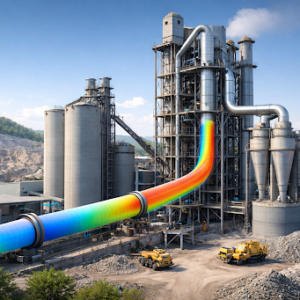
Image generated by: ChatGPT