

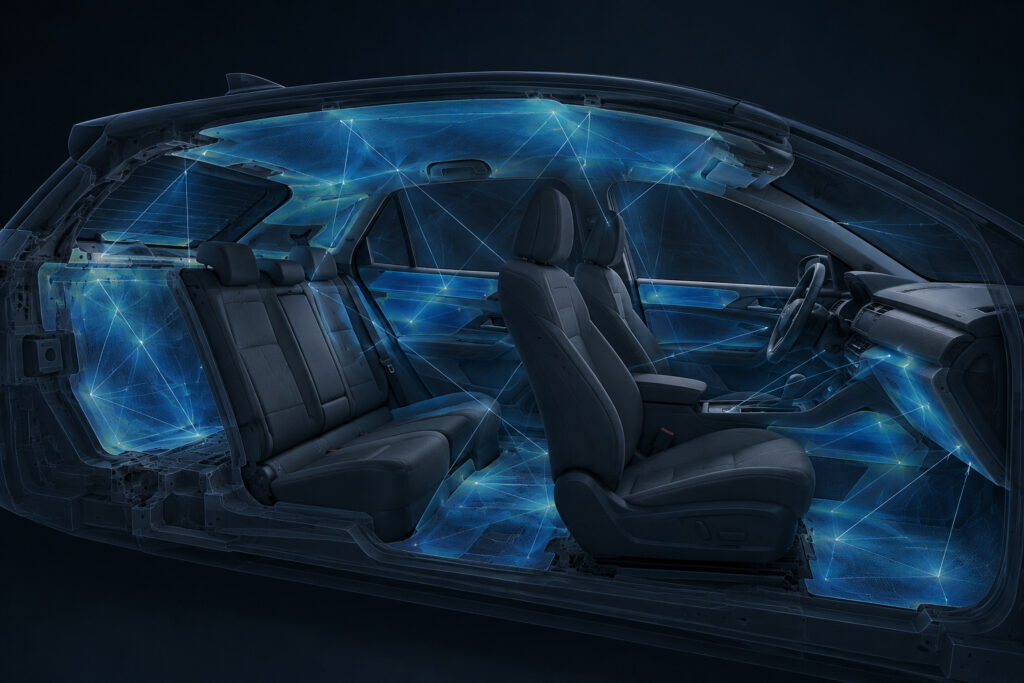
Cadence has described its Actran radiosity solver for high-frequency acoustic simulation, a challenge in automotive, aerospace, architectural and industrial design. Finite element and boundary element methods need finer meshes at higher frequencies, raising computational demands. The solver instead models acoustic energy moving between surfaces, assuming diffuse reflection, which is more valid at high frequencies.
It uses surface geometry and material properties, without a volumetric mesh, and calculates energy exchange using view factors. Transmission loss assigned to surfaces lets reflection, absorption and transmission be modeled together. Examples include vehicle cabins, factories, warehouses and urban noise mapping. It complements finite and boundary element methods at low frequencies and hybrid approaches at mid frequencies, aiming to cover the full frequency range. Overall, the approach shifts the focus from resolving acoustic waves to tracking how energy is exchanged between surfaces.
Image generated by: ChatGPT