
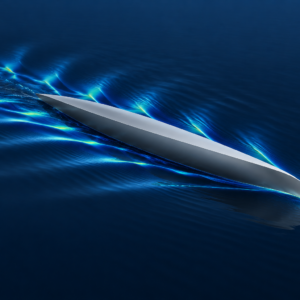

Predicting exactly how a ship will sit in the water as it gathers speed has long been one of naval engineering’s quieter challenges. Navier AI examined this question through the Wigley hull, a scale-model shape favoured in marine research because its form is defined by a mathematical equation rather than physical measurement, reducing uncertainty tied to the hull’s own geometry.
The study aims to determine whether flow simulations can reliably predict a hull’s sinkage and trim across a range of speeds, and to assess the numerical uncertainty behind its resistance calculations, rather than adjusting results to fit known data afterward. Using OpenFOAM, an open-source simulation platform, engineers modelled the hull moving freely through water while tracking:
- Sinkage across a sweep of speeds, validated directly against earlier towing-tank measurements
- Computed trim trends, reported but not checked against experimental data
- Resistance, assessed through grid, time-step, and iterative uncertainty studies
- The simulated wave tank itself, independently verified before trusting hull results
Sinkage predictions closely matched the towing-tank data, and an early discrepancy was traced to mesh alignment near the waterline rather than the physics itself, then corrected at its source. The case study underscores a simple discipline: credible simulation depends on fixing errors where they originate, not smoothing them over afterward.
Image generated by: ChatGPT