


Kerr frequency combs are light-frequency patterns generated inside tiny ring-shaped microresonators, widely used in telecommunications, spectroscopy, and precision measurement. Such behavior has traditionally been modeled using mean-field approaches like the Lugiato-Lefever Equation, which rely on approximations that can miss critical spatiotemporal details.
Researchers used Flexcompute‘s Tidy3D GPU-native FDTD solver to simulate comb formation directly from Maxwell’s equations, capturing effects including self-steepening and Raman scattering without the slowly varying envelope approximation. GPU acceleration enabled the large-scale 3D, time-domain simulation. Results reproduced stable soliton, breathing soliton, and Turing-pattern states, and revealed subcomb frequency mismatch relevant to soliton formation and comb noise, positioning full-wave simulation as a practical, ready-to-use tool for designing next-generation microresonator devices.
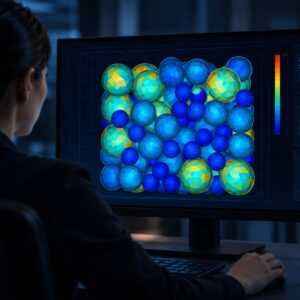
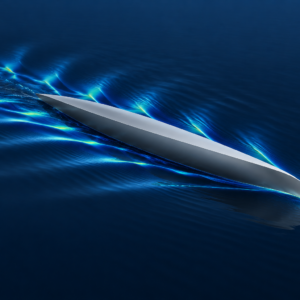
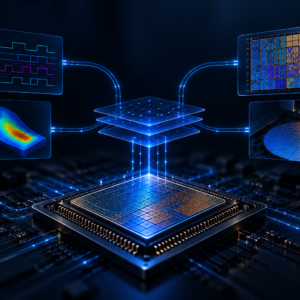
Image generated by: ChatGPT